


Cement Plant Water Treatment, Fuel Testing And Flow Measurement In Pakistan
For cement plant water treatment in Pakistan, the chemicals, online water analysers and flow meters come from Khan Associates, which operates from Karachi and Lahore.
The same supply extends into the plant laboratory and the stack: drying ovens, muffle furnaces and elemental analysis for coal and alternative fuel testing, ion chromatography for chloride work, continuous emission monitoring where RDF is co-processed, and coagulants for yard runoff and sewage treatment. It is aimed at the utilities and mechanical engineers who keep kilns and mills cooled, the process and fuel laboratory staff who qualify coal and RDF, and the environment managers who report to the EPA. Khan Associates’ import and distribution business dates from 1994.
Two pressures meet at many cement plants. Cooling water is drawn from hard groundwater in dry districts and has to keep kiln and mill bearings within temperature, while the fuel arriving at the kiln changes with every coal source and every load of refuse-derived fuel. Tell us whether your question concerns water, fuel or emissions, and we will reply with a recommended set of chemicals or instruments and a quotation.
Cement Plant Applications And What We Supply
Each row links a cement plant duty to the product family we supply for it. Rows marked for confirmation are covered further down.
| Cement Plant Duty | Supplied By Khan Associates | Brand Or Product Range |
|---|---|---|
| Kiln roller, mill and compressor cooling circuits (open towers) | Antiscalants, corrosion inhibitors and biocides; conductivity, hardness, pH and chlorine measurement | Water treatment chemicals range; HACH |
| Closed cooling loops | Nitrite-based corrosion inhibitors, benzotriazole for copper-bearing coolers | Water treatment chemicals range |
| RO make-up from hard groundwater | RO antiscalants, biocides and activated carbon; conductivity monitoring | Water treatment chemicals range; HACH |
| Waste heat recovery boiler water | Dissolved oxygen, pH, conductivity and silica measurement | HACH |
| Tubewell, make-up and cooling circuit flow | Electromagnetic insertion and full-bore meters | McCrometer |
| WHR steam energy | V-Cone differential pressure meters in the ExactSteam configuration | McCrometer |
| Coal and alternative fuel moisture, ash and volatile matter; coal mill fineness | Drying ovens, muffle furnaces, moisture analysers, balances, sieve shakers | Zenithlab; laboratory range |
| Carbon, hydrogen, nitrogen and sulphur in coal, RDF and biomass | CHNS-O elemental analyser (model to be confirmed) | VELP Scientifica |
| Chloride after combustion of fuel samples | Ion chromatography | Wayeal |
| Kiln stack monitoring with RDF co-processing | Continuous emission monitoring systems (configuration to be confirmed) | Wayeal |
| Yard runoff, colony sewage and settling ponds | Coagulants and flocculants | Bluwat |
Supply And Site Support For Cement Plants
Cement plants tend to sit far from the cities, near their limestone, so support has to be planned rather than improvised. Installation, commissioning, calibration and the training of plant staff are handled by Khan Associates engineers for the instruments listed, with the scope set out on our installation and calibration services page. McCrometer meters come with application sizing and installation guidance, including hot-tap retrofits, and HACH reagents are stocked locally so a remote site is not waiting on an import for routine testing.
Chemistry is chosen on the plant’s own water and effluent. Bluwat coagulants are selected after jar testing on your sample and are delivered with a certificate of analysis for every batch, and a cooling water programme should be built around a recent analysis of make-up and circulating water rather than a standard dose. HACH, McCrometer, Bluwat, Zenithlab and VELP are supplied under authorized distribution, and Wayeal instruments under exclusive distribution for Pakistan.
Kiln Roller, Mill And Compressor Cooling Circuits
Most cement plant cooling water goes to bearings. Kiln support rollers, raw and cement mill bearings, gearbox and lube oil coolers and air compressors are typically cooled from a recirculating system with a cooling tower and reservoir, and CemNet puts a major bearing at around 60 litres per minute. Because only about a tenth of the circulating water is lost to evaporation and leaks, the dissolved salts in the rest concentrate cycle after cycle.
That concentration is where failures start. Carbonate deposits as the water warms, narrowing cooler passages and raising bearing temperatures until a kiln or mill has to slow or stop, and warmer water is also more corrosive to the cooler tubes. Conductivity is the everyday control for cycles of concentration, with hardness and alkalinity showing scaling potential, pH and chloride showing corrosion risk, and free chlorine confirming biological control in the tower. HACH sc controllers with conductivity and pH sensors run these continuously, and DR spectrophotometers or pocket colorimeters cover the daily checks from the HACH instrument range.
The treatment itself comes from our cooling tower and closed-loop treatment chemicals: phosphonate and polymer antiscalants such as HEDP, PBTCA and polyacrylates, benzotriazole and tolyltriazole where coolers contain copper alloys, nitrite-based inhibitors for closed loops, and oxidising and non-oxidising biocides for the tower basin. Dose follows the make-up water analysis and the cycles you can hold.
Water sprayed into the gas conditioning tower and the mills is a separate use. It evaporates in the process and CemNet estimates injection at around 0.2 tonnes per tonne of cement, so it is not treated like cooling water, but suspended solids and hardness in that supply still block spray nozzles and are worth checking where nozzle maintenance is frequent.
Make-Up Water, RO Plants And The WHR Boiler
Where make-up comes from tubewells, groundwater hardness and TDS often set the limit on how many cycles a cooling tower can run. Plants that install reverse osmosis to soften make-up need RO antiscalants and biocides to protect the membranes, activated carbon where the feed is chlorinated, and conductivity on the permeate to show when the membranes are losing rejection.
Waste heat recovery changed the water picture at several Pakistani plants. A WHR boiler on the preheater and cooler exhaust gases is a steam cycle of its own, and it stops and starts with the kiln, so the boiler water sits idle whenever the kiln is down. Feedwater dissolved oxygen, pH, conductivity and silica are the parameters to hold, measured online with HACH probes on sc controllers and checked in the laboratory. Continuous measurement for both the cooling and WHR systems is grouped under our process solutions and online instrumentation.
Flow Measurement For Water Accounting And WHR Steam
Water consumed per tonne of cement cannot be managed without metering. That means tubewell abstraction, make-up to each cooling tower and the main circuit flows measured separately, rather than one meter at the plant gate. A drop in flow to a bearing cooling circuit is also worth catching before the bearing temperature does.
On existing lines, a McCrometer FPI Mag goes in under pressure via a hot tap, so the circuit keeps running, which suits a plant where cooling water cannot be interrupted while the kiln is on. New pipework and tubewell discharge take full-bore Ultra Mag or Dura Mag meters. On the WHR side, V-Cone meters in the ExactSteam configuration measure steam energy for plants that need to account for power generated from waste heat. Sizing is driven by pipe diameter, fluid and straight run, so McCrometer electromagnetic and V-Cone meters are specified against your pipework.
Coal And Alternative Fuel Testing In The Plant Laboratory
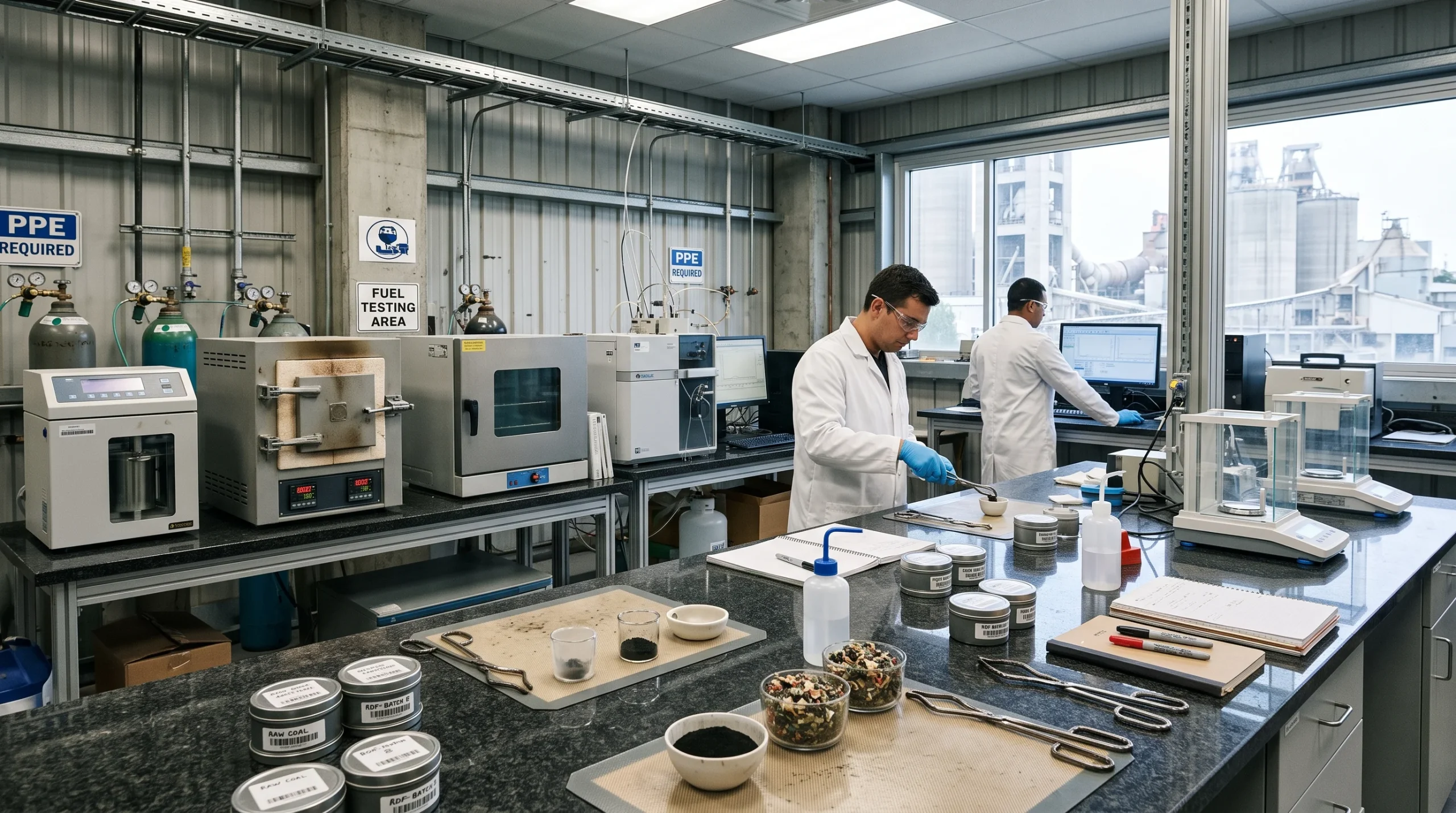
Kiln fuel in Pakistan is rarely one fuel. PACRA’s FY24 sector study shows coal arriving from South Africa, Indonesia and Afghanistan alongside rising local production, and plants have co-fired refuse-derived fuel for years: Fauji Cement commissioned an RDF plant fed by municipal waste from Rawalpindi and Islamabad in 2008, and DG Khan Cement built RDF capacity at Khairpur from 2011. Each source brings different moisture, ash, sulphur and chlorine to the kiln, and the laboratory is where that variation is caught before it reaches the burner.
The routine fuel tests are proximate. Moisture by oven drying, ash in a muffle furnace, and volatile matter at controlled temperature in a covered crucible need drying ovens and furnaces that hold their setpoint, with analytical balances and moisture analysers for quick checks. Coal mill fineness, the sieve residue that governs how the flame behaves, needs a sieve shaker. Zenithlab ovens and the furnaces, balances, moisture analysers and sieve shakers in our laboratory supplies and instruments range cover this bench.
Elemental composition is the next step. VELP positions its EMA 502 CHNS-O elemental analyser for coal, biofuels, biomass and solid recovered fuels, with methods including ISO 21663 for solid recovered fuel and ASTM D5373 for coal. Sulphur matters for SO2 at the stack and for clinker chemistry, and nitrogen for NOx. Elemental analysers appear in our laboratory range; confirm the EMA 502 configuration for your fuels with us before specifying, and see the VELP Scientifica range for the supporting laboratory equipment.
Chlorine deserves its own line in any RDF specification, because it promotes build-ups and internal cycles in the kiln system. Under EN 15408 the sample is combusted and the absorbed chlorine determined, commonly by ion chromatography, and Wayeal ion chromatography systems handle that determination once the combustion step is in place.
Two limits apply. Calorific value is measured by bomb calorimetry, and calorimeters are not in our range; CHNS data support a calorific estimate but do not replace the measurement. RDF is also bulky and heterogeneous, so a representative laboratory sub-sample depends on shredding and milling equipment that we do not supply.
Stack Monitoring Where RDF Is Co-Processed
The Pakistan EPA’s Guidelines for Processing and Using Refuse Derived Fuel in Cement Industry (2012) attach monitoring to co-processing: particulate matter online with monthly reporting, NOx and CO monthly, SO2 twice a year, dioxins and furans annually, and heavy metals on a set schedule, with RDF feed designed to stop automatically if limits are exceeded. The NEQS set 300 mg/Nm³ for particulate matter from cement kilns.
Wayeal continuous emission monitoring systems track stack emissions in real time and are part of the Wayeal range we distribute. The measured parameters, sampling system and dust monitor for a cement kiln stack have to be confirmed for your duct and approval conditions before you specify. Dioxins, furans and metals remain laboratory determinations for a certified environmental laboratory.
Yard Runoff, Colony Sewage And Plant Effluent
A dry-process cement plant produces little process effluent, so the wastewater questions are specific. Rain and washdown water from clinker, coal and raw material yards carry fine dust and are strongly alkaline; township and colony sewage goes to an on-site treatment plant; and workshop and vehicle-wash water carries oil.
Yard runoff is the stream where coagulation earns its place: settling ponds clear faster and discharge cleaner when a coagulant and polymer are dosed ahead of them, although the high pH of clinker-laden water can shift the best coagulant and dose, which is why the jar test matters. Bluwat polyaluminium chloride and polyacrylamide are selected on that basis, and cationic polymer grades serve sludge dewatering at the colony sewage plant. Cooling tower blowdown is a salinity problem, not a suspended-solids one, and oily water needs separation first; coagulant is not the answer to either.
Cement Plants In The North And South: Which Office Supports You
PACRA’s FY24 study counts 27 operational plants run by 16 companies, 21 of them in the north and 6 in the south, and the Economic Survey put installed capacity at 84.58 million tonnes a year for FY24-25, with utilisation around 53 percent. Southern plants carry most of the export trade. Plants in Punjab and Khyber Pakhtunkhwa are supported by our Lahore office, and plants around Karachi, Hub, Nooriabad and Thatta by our Karachi office. We have no office at the plant clusters themselves, so site visits for sampling, installation or training are scheduled with each enquiry.
Low utilisation has a water consequence of its own. Kilns that stop more often leave cooling circuits and WHR boilers standing, which is when corrosion and biological growth take hold; shutdown and restart are the periods to check most carefully.
What To Send For A Water, Fuel Or Emissions Enquiry
- ✔Cooling water: circuit type (open tower or closed loop), what it cools, recent make-up and circulating water analyses, current treatment and any scaling or corrosion history.
- ✔Make-up and WHR: water source, RO details if installed, WHR boiler pressure and current monitoring points.
- ✔Flow measurement: pipe diameter and material, fluid, straight run on either side of the meter position, and whether the pipe can be isolated.
- ✔Fuel laboratory: fuels in use (coal origins, RDF, biomass), the parameters and standards you test to, and daily sample numbers.
- ✔Emissions: stack dimensions, parameters in your EPA approval and any existing analysers.
- ✔Effluent: stream, flow, a recent analysis and current treatment.
- ✔Site location and any shutdown window you want the work to fit.
XRF and XRD for raw meal and clinker, physical cement testing equipment such as Blaine, Vicat and compressive strength machines, bomb calorimeters, sample mills and crushers, and kiln, cooler or WHR plant construction are not supplied by us.
Cement Plant Water, Fuel And Emissions FAQs
What Should We Monitor In A Bearing Cooling Water Circuit?
Conductivity to control cycles of concentration, hardness and alkalinity for scaling potential, pH and chloride for corrosion, and free chlorine where the tower is chlorinated. Conductivity and pH are worth measuring continuously; the others can be checked daily or weekly depending on how close the circuit runs to its scaling limit.
Why Does Cooling Tower Scaling Get Worse In Summer?
Evaporation rises with temperature, so more water is lost and dissolved salts concentrate faster, while carbonate becomes less soluble as the water warms. Unless blowdown and inhibitor dose are adjusted, cycles of concentration drift upward and deposits form in the hottest coolers first.
Can A CHNS Analyser Replace A Bomb Calorimeter For Fuel Testing?
No. Calorific value is determined by bomb calorimetry, and calorimeters are not in our range. CHNS results give carbon, hydrogen, nitrogen and sulphur, which support a calorific estimate and SO2 and NOx planning, but they do not replace the measurement.
How Is Chlorine In RDF Determined?
The sample is combusted, commonly in an oxygen bomb or furnace, the combustion gases are absorbed, and the chloride is measured, often by ion chromatography as described in EN 15408. The ion chromatograph handles the measurement; the combustion step has to be available as well.
Which Flow Meter Suits A Cooling Water Line That Cannot Be Shut Down?
An insertion electromagnetic meter such as the McCrometer FPI Mag, installed through a hot tap on the running line. Send the line size, material and available straight run so the sizing can be confirmed.
Do We Need Continuous Emission Monitoring If We Burn RDF?
The Pakistan EPA’s RDF guidelines call for online particulate monitoring with monthly reporting, alongside periodic gas, dioxin and metal measurements. Your EPA approval conditions decide the exact parameters, so check them before specifying a system.
Will Coagulant Chemistry Treat Cooling Tower Blowdown?
No. Blowdown carries dissolved salts, which coagulants do not remove. Coagulants are useful on yard runoff and in settling ponds, where the problem is fine suspended dust.
Do You Supply XRF Or Cement Physical Testing Equipment?
No. Raw meal and clinker chemistry by XRF, and physical tests such as Blaine fineness, setting time and compressive strength, are outside our range. We cover the water, fuel, flow and emissions side of the plant.
Request A Proposal For Your Cement Plant
Send the water analyses, fuel list or stack details that match your question, together with the site location, and we will return a proposal covering the chemicals or instruments, their installation and calibration, and a formal quotation. For cooling water, recent make-up and circulating water analyses are the starting point; for fuel testing, the list of tests you run. Enquire through the form, by email, by phone to either office or on WhatsApp.