


Food And Sugar Industry Solutions In Pakistan
Food laboratory equipment in Pakistan has to cover a wide spread of tests, and Khan Associates equips sugar mills, dairies, flour and feed mills and edible oil refineries for most of them from Lahore and Karachi: protein, fat, fibre and moisture analysers, saccharimeters and refractometers for pol and Brix, culture media and incubation for microbiology, and process water testing and UV disinfection.
The central application is producing numbers that hold up, whether the challenge is a cane grower disputing a pol reading, a buyer checking a label, a provincial food authority sample or an importing market. Sugar process chemicals such as mill sanitation biocides, juice flocculants and evaporator antiscalants are covered separately on our chemicals for the sugar industry and distilleries page. Tell us the methods you work to and we will propose an instrument configuration with a quotation.
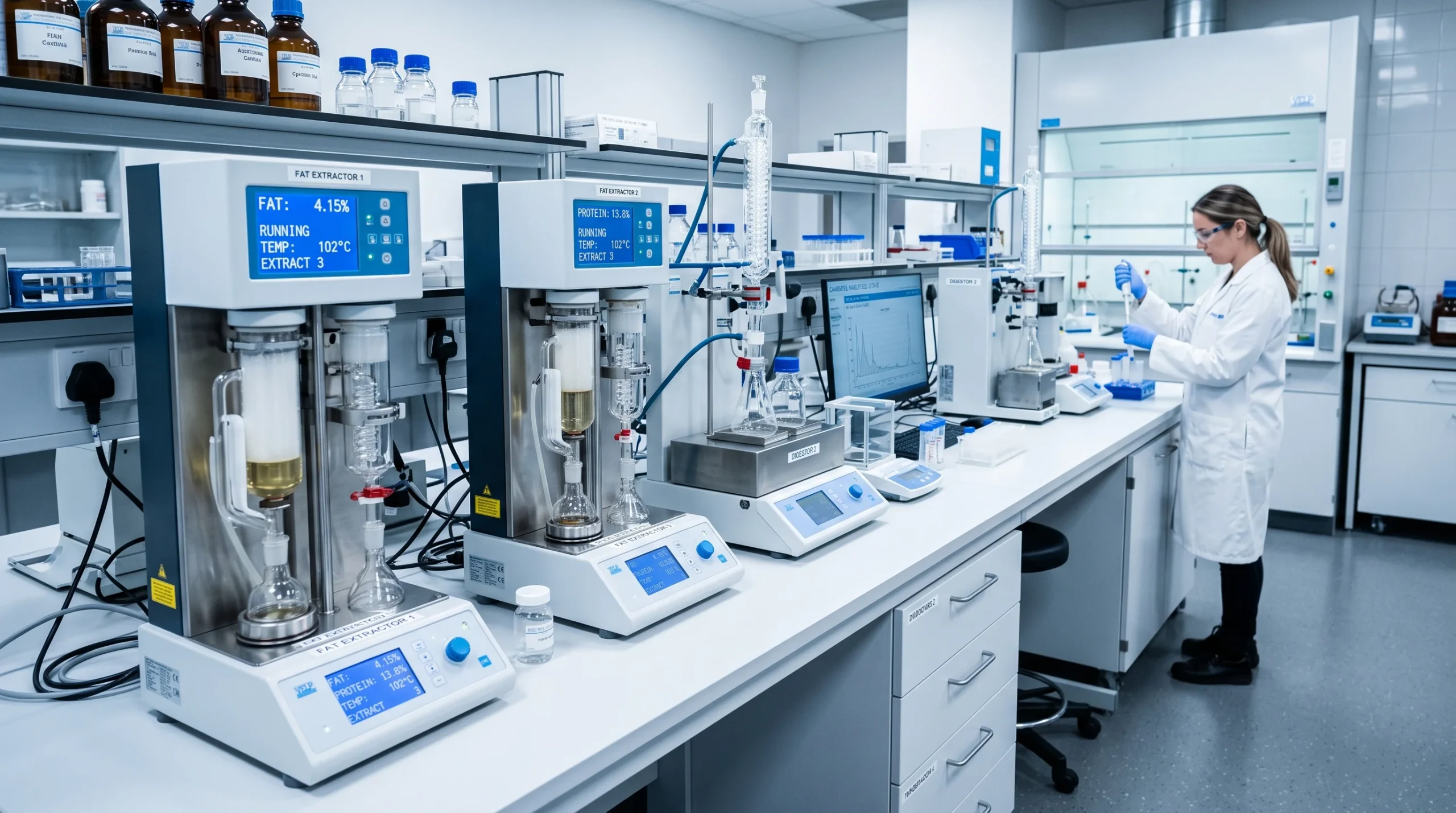
Food And Sugar Laboratory Applications And Instruments
Use this to match a test to the instrument family that runs it. The method decisions behind each row, particularly for protein and fibre, are explained in the sections that follow.
| Laboratory Application | Instrument Or Media Supplied | Brand |
|---|---|---|
| Pol (sucrose) in cane juice, raw and refined sugar | Saccharimeters reading °Z to ICUMSA methods, quartz control plates | Rudolph Research |
| Brix in juice, syrup and molasses | J Series automatic refractometers, Brix calibration fluids | Rudolph Research |
| Protein by Kjeldahl or Dumas | DK and DKL digestion with UDK distillation, NDA 701 and NDA 702 analysers | VELP Scientifica |
| Fat by Randall extraction | SER 148 and SER 158 solvent extractors | VELP Scientifica |
| Crude, detergent and dietary fibre | Fibre analysers and AOAC dietary fibre systems | VELP Scientifica |
| Oxidation stability of oil, ghee and banaspati | OXITEST to AOCS Cd 12c-16 | VELP Scientifica |
| Moisture and ash | Hot-air drying ovens, muffle furnaces | Zenithlab; laboratory range |
| Pathogens and indicator organisms | Dehydrated, ready-to-use, chromogenic and selective media | Biokar Diagnostics |
| Boiler, cooling and process water | Laboratory, portable and online water analysis | HACH |
| Process water disinfection | UV systems | Trojan Technologies |
| Heavy metals in food and water | Atomic absorption spectrophotometers | Wayeal |
| Crushing-season effluent | Coagulants and flocculants | Bluwat |
Commissioning Before The Crush, And Consumables Held Locally
Khan Associates has supplied sugar mills since 1994, through more than thirty crushing seasons, and the lesson from those seasons is about timing. Installation, method configuration and operator training are carried out by our engineers, and for a mill they need to land in the off-season, because an instrument failure mid-crush with no trained backup operator is the scenario every mill laboratory wants to avoid.
Consumables decide uptime on a proximate bench. Genuine VELP consumables such as KjTabs catalyst tablets and Vreceiver boric acid formula are held locally, because a Kjeldahl bench that runs out stops mid-run, and routine spare parts are stocked in Pakistan for the same reason. Each instrument comes with the manufacturer’s warranty, and each calibration leaves a record you can put in front of a buyer or an auditor. The full list of installation, calibration and training support is on our laboratory services page.
Two Different Plants, One Laboratory Problem
A sugar mill and a food processor look like the same customer on a supplier’s list and behave nothing alike.
A sugar mill runs a compressed, seasonal operation. The laboratory sits at the centre of it because pol and Brix readings drive payment for cane, process control decisions and final product grading, and they are taken around the clock for the length of the crush. The failure that matters is an instrument going down mid-season, when nothing can be sent away for repair and the plant does not stop.
A food processor runs year-round against a different pressure: label declarations that have to be true, buyer specifications, provincial food authority sampling and, for exporters, foreign rejection risk. Its laboratory is built around proximate analysis and microbiology rather than concentration measurement.
Sugar Analysis: Pol, Brix And Purity
These three numbers are the language of a sugar mill laboratory, and they are regularly confused by people buying instruments for one.
Pol is an optical rotation measurement made on a polarimeter or saccharimeter, and it approximates sucrose content. Brix is a refractive index measurement of total dissolved solids, which includes sucrose along with everything else dissolved in the juice. Purity is the ratio between them. That is why a mill cannot substitute one instrument for the other: a refractometer will not tell you sucrose, and a saccharimeter will not tell you total solids. A laboratory doing process control on juice, syrup, massecuite and molasses needs both.
Rudolph Research saccharimeters read directly in degrees Sugar (°Z) according to ICUMSA methods, which is the basis on which raw and refined sugar pol is reported. J Series automatic refractometers cover Brix in juice, syrup and molasses, with electronic temperature control that matters more than it sounds during a Pakistani crushing season, when ambient temperature in a mill laboratory moves substantially between a night shift and an afternoon.
The part most mills under-budget is calibration. Rudolph’s standards laboratory supplies quartz control plates and Brix calibration fluids with NIST and ICUMSA traceability. A saccharimeter without a quartz plate is an instrument nobody can audit, and pol readings that determine cane payment need to be defensible to the grower as well as to the mill. For that reason the Rudolph Research standards are supplied alongside the instruments.
Proximate Analysis: Protein, Fat, Fibre And Moisture
Proximate analysis is the daily workload of a food, feed, dairy, flour or oil laboratory, and each component has a genuine method decision behind it.
Protein: Kjeldahl Or Dumas
Both determine nitrogen and convert it to protein, and the choice is operational rather than scientific.
Kjeldahl remains the reference method behind most official specifications. VELP Scientifica DK and DKL digestion units with UDK distillation — from the manual UDK 129 through the UDK 159 and the fully automatic UDK 169 with integrated titration and autosampler — work according to AOAC, ISO, EPA and DIN methods for Kjeldahl nitrogen, protein, TVBN and ammoniacal nitrogen. If your buyer or regulator names Kjeldahl, this is what you need, and the model choice follows daily sample load rather than preference.
Dumas combustion gives nitrogen and protein in minutes without aggressive reagents. VELP NDA 701 and NDA 702 analysers run unsupervised, which changes the economics for a high-throughput feed or flour laboratory and removes concentrated sulphuric acid and digestion fume handling from the bench. Where speed and operator safety drive the decision, Dumas complements or replaces Kjeldahl.
A practical point for feed mills and flour mills specifically: protein determines grading, blending decisions and price. A protein result that drifts is a commercial exposure, not just a QC finding.
Fat
Fat determination by solvent extraction using the Randall method is covered by VELP SER 148 and SER 158 extraction units. This is standard for dairy, feed, snacks, bakery and meat products, and it sits alongside protein on the same proximate bench.
Fibre: Three Different Tests That Get Treated As One
This is where laboratories most often buy the wrong capability.
Crude fibre is the classical determination used for feed and many food specifications. Detergent fibre — NDF and ADF — is a separate approach used mainly in animal nutrition to describe cell wall fractions. Dietary fibre is different again: it is an enzymatic-gravimetric determination under AOAC methods, and it is what nutrition labelling requires. A laboratory that buys a crude fibre analyser because a label needs a dietary fibre figure has bought the wrong instrument. VELP supplies crude and detergent fibre analysers alongside AOAC-compliant dietary fibre systems, so the answer depends entirely on which number you have to report.
Moisture And Ash
The unglamorous half of proximate analysis. Moisture by oven drying and ash by ignition need controlled-temperature equipment that actually holds its setpoint, because both are gravimetric and an oven drifting by a few degrees moves the result. Zenithlab hot-air drying ovens cover this layer, and a muffle furnace for ashing completes the gravimetric bench.
Oxidation Stability For Edible Oil, Ghee And Banaspati
Pakistan has a large edible oil and vanaspati sector, and its central quality question is how long a product stays acceptable on a shelf in a hot climate.
Peroxide value tells you the state of oxidation at the moment you test. It does not tell you how fast oxidation will proceed. Accelerated oxidation stability testing does, and VELP OXITEST performs it according to AOCS Cd 12c-16 on the whole sample rather than on extracted fat, without chemical reagents. For a producer setting a shelf-life claim, comparing antioxidant systems, or investigating why one batch developed rancidity ahead of another, this is a measurement that answers the actual question rather than a proxy for it.
Food Microbiology: Pathogens And Indicators
Food microbiology in Pakistan is driven by two forces: provincial food authority sampling of the domestic market, and buyer or importer requirements on the export side.
The routine workload is pathogen detection and indicator enumeration — Salmonella, Listeria, E. coli including O157, coliforms, and total plate count — plus yeast and mould where product water activity and sugar content allow spoilage. Dairy adds its own layer across raw milk, pasteurised product and the processing environment.
Biokar Diagnostics culture media, which we distribute in Pakistan, cover this workload. The range covers dehydrated and ready-to-use media, chromogenic media that cut confirmation steps for laboratories processing high sample volumes, selective media such as Baird-Parker for staphylococci and Bismuth Sulfite for Salmonella, and reagents and detection kits supporting ISO and AOAC reference methods. A pathogen result is presence or absence, so a media batch that under-recovers does not give a slightly wrong number; it gives a false negative.
Two practical notes. Media performance is the whole test: a batch that under-recovers invalidates the day’s results without announcing itself, which is why valid remaining shelf life and cold-chain-aware handling matter more than unit price. And microbiology needs incubation at more than one temperature plus a sterilizer for media and glassware preparation — a laboratory with media and no reliable incubation is not yet a microbiology laboratory.
Process And Utility Water
Both plant types run substantial water systems that sit outside the product laboratory but end up in the same QC manager’s remit.
A sugar mill operates bagasse-fired boilers, condenser and cooling water, imbibition water at the milling tandem and condensate recovery. Boiler feedwater chemistry decides tube life and steam economy, and during a crush there is no window to correct a problem that has been building for weeks. A food processor runs process water that contacts product, plus utility systems and CIP.
The relevant parameters are hardness, alkalinity, silica, conductivity, pH, chlorine residual and turbidity, and they are covered across laboratory, portable and online formats by HACH instruments and reagents. For the treatment side of bagasse boilers and cooling towers, see our boiler and cooling water chemicals.
UV Disinfection For Process Water
Where water contacts product, microbiological security is needed without anything that alters the product. UV inactivates microorganisms without adding a chemical, without leaving a residual and without changing taste, odour or mineral profile, which is why it appears on process water lines in food plants rather than at the head of the treatment train. We supply Trojan Technologies UV systems, whose applications include food and beverage processing.
Sizing depends on flow rate and on the water quality reaching the reactor, so this is a specification conversation rather than a catalogue selection.
What You Can Realistically Test In-House, And What To Send Out
This is where laboratory budgets most often get wasted.
Realistic in-house: proximate analysis in full, pol and Brix, oxidation stability, microbiology including pathogens and indicators, moisture and ash, and process water chemistry. These are the tests you run daily or weekly, where turnaround matters and where external laboratory fees accumulate quickly.
Heavy metals sit at the boundary and usually fall on the in-house side for a plant with steady volume. Atomic absorption spectrometry covers lead, cadmium and similar contaminants, and Wayeal atomic absorption spectrophotometers are verified for heavy metals testing in food and water samples.
Better sent out, for most producers: aflatoxin and other mycotoxins, and pesticide residue screening. These are the parameters behind a significant share of foreign rejections of Pakistani food exports, and they are also the parameters that need chromatography-mass spectrometry class instrumentation, method validation and trained analysts to produce a result an importing authority will accept. Unless your volume genuinely justifies building that capability, an accredited external laboratory is the correct answer.
If you do intend to build mycotoxin or residue capability, talk to us about scope first rather than starting from an instrument.
Crushing-Season Effluent
Sugar mill effluent is a seasonal problem, which makes it different from almost every other industry we supply.
During crushing, a mill generates high-volume, high-organic-load effluent from mill house washings, condenser cooling water, floor washings and filter station discharge. The load is largely biodegradable — unlike tannery or textile effluent, where the difficulty is that the COD will not break down at all — so the treatment challenge is capacity and surge rather than chemical intractability. Then the plant stops for months, and a biological system that has been running hard has to be restarted the following season.
Practically, that argues for equalisation ahead of biological treatment, coagulation and flocculation for suspended solids and colour, and polymer for sludge dewatering during the peak. Bluwat coagulants and flocculants handle this duty, alongside the wider set of ETP chemicals for crushing season. COD and BOD verification runs on the same VELP thermoreactors and respirometric sensors already described.
Local Support Across The Sugar Belt
Most of Pakistan’s sugar mills sit in central and southern Punjab and in Sindh, with a smaller group in Khyber Pakhtunkhwa, while food processing is concentrated around Lahore, Faisalabad and Karachi. Punjab mills and food plants work with our Lahore laboratory supply office; Sindh mills and Karachi processors are looked after by our Karachi office.
For a mill in either province, the useful moment to contact us is the off-season, with your crushing dates, so that new instruments are installed, quartz plates and Brix standards are in place and operators are trained before juice arrives. Food processors running year-round can plan around their own audit or buyer inspection dates instead.
Building Or Upgrading A Food Or Sugar Laboratory
- ✔Which reference methods you are required to follow, and by whom — a buyer specification, a provincial food authority, an export market, or an internal standard. This decides the instrument more than anything else.
- ✔Your daily and peak sample load per test. For a sugar mill, peak means mid-crush, not the annual average.
- ✔Which tests you currently outsource and what you pay for them annually. That figure usually decides what is worth bringing in-house.
- ✔Product categories you handle, since dairy, oils, cereals, feed and sugar have different proximate and microbiological profiles.
- ✔For microbiology: target organisms, reference methods, monthly media consumption and your current incubation capacity.
- ✔For a sugar mill: whether you are equipping a new laboratory or replacing mid-life instruments, and your crushing season dates, because commissioning and training have to land before the crush and not during it.
- ✔For process water or UV: flow rate, existing treatment and a recent water analysis.
Food And Sugar Laboratory FAQs
What Is The Difference Between Pol And Brix, And Do We Need Both Instruments?
Yes, you need both. Pol is an optical rotation measurement approximating sucrose, made on a polarimeter or saccharimeter. Brix is a refractive index measurement of total dissolved solids, which includes sucrose plus everything else in solution. Purity is the ratio of the two. Neither instrument can produce the other’s number.
Should We Buy Kjeldahl Or Dumas For Protein?
If your specification or regulator names Kjeldahl, buy Kjeldahl. Beyond that it is an operational decision: Dumas gives results in minutes without aggressive reagents and runs unsupervised, which suits high-throughput feed and flour laboratories and removes concentrated acid handling from the bench. Kjeldahl remains the reference method behind most official specifications. Some laboratories run both.
Our Label Needs A Dietary Fibre Figure. Can Our Crude Fibre Analyser Do It?
No. Crude fibre, detergent fibre (NDF and ADF) and dietary fibre are three different determinations. Dietary fibre for nutrition labelling is an enzymatic-gravimetric method under AOAC, and it needs a dietary fibre system rather than a crude fibre analyser. This is the most common wrong purchase we see on a proximate bench.
Why Does Our Sugar Laboratory Need Quartz Control Plates?
Because pol readings often determine cane payment and product grading, and an uncalibrated saccharimeter produces numbers that cannot be defended to a grower, a buyer or an auditor. Quartz control plates and traceable Brix fluids are how you demonstrate the instrument was reading correctly on the day.
Can You Test The Shelf Life Of Our Cooking Oil Or Ghee?
We supply the instrumentation for accelerated oxidation stability testing rather than a testing service. OXITEST measures oxidation stability according to AOCS Cd 12c-16 on the whole sample without reagents, which is what you need for comparing antioxidant systems or supporting a shelf-life claim. Peroxide value alone tells you the current state, not the rate.
Do You Supply Aflatoxin Or Pesticide Residue Testing Equipment?
For most food producers we would advise against building this in-house. Mycotoxin and residue analysis needs chromatography-mass spectrometry class instrumentation, validated methods and trained analysts before a result will be accepted by an importing authority. An accredited external laboratory is usually the right answer. If your volume genuinely justifies the capability, discuss scope with us before selecting any instrument.
How Much Media Does A Food Microbiology Laboratory Get Through?
It depends entirely on sample load, target organisms and whether you prepare from dehydrated media or buy ready-to-use. Tell us your monthly sample numbers and the organisms you screen for and we will work it out with you. What matters more than volume is supply continuity and valid remaining shelf life — media that arrives near expiry is a false economy.
We Are A Sugar Mill. When Should We Order Laboratory Instruments?
Well before the crush. Installation, method configuration and operator training need to happen while the plant is quiet, and a mid-season instrument failure with no trained backup operator is the scenario to avoid. Talk to us in the off-season with your crushing dates.
Plan Your Laboratory Before The Next Crush
Tell us the reference methods you work to, your sample load and what you currently send outside, and we will put together an instrument and consumable configuration with a formal quotation — including a clear view on anything better left to an external laboratory. The enquiry form is the quickest route, and both offices take calls.
Khan Associates
Lahore Corporate Office:
184 S, Quaid-e-Azam Industrial Estate, Kot Lakhpat, Lahore, Pakistan.
+92-42-35146680-83
Karachi Office:
908-909, 9th Floor, Portway Trade Centre, Plot 189/A, S.M.C.H.S, Main Shahrah-e-Faisal, Karachi, Pakistan.
+92-21-34540251-52
khi@khanassociates.net
WhatsApp: +92 301 4168242, 9:00am to 5:00pm
Email: info@khanassociates.net