


Pharmaceutical QC Instruments, Microbiology And Water Monitoring In Pakistan
Khan Associates supplies pharmaceutical QC instruments in Pakistan, through offices in Lahore and Karachi, to the quality control, microbiology and utilities teams of drug manufacturers.
The range covers polarimeters, density meters and refractometers for pharmacopoeial physical tests; HPLC, gas chromatography and atomic absorption for assay and impurity work; online conductivity, TOC and UV for purified water systems; and culture media, incubators and sterilizers for microbial limits and environmental monitoring. The company has been importing laboratory instruments since 1994, and each brand named here comes through the manufacturer’s official distribution channel.
For many QC laboratories the pressure point is moving from the measurement to the evidence behind it. DRAP adopted the PIC/S GMP guidelines through S.R.O. 1587(I)/2025 and began phased implementation in February 2026 with the documentation chapter, so instrument records, calibration traceability and media certificates now carry more weight at inspection. Send us the monograph or method, the parameter and your current equipment to receive a suggested set-up and a formal quote.
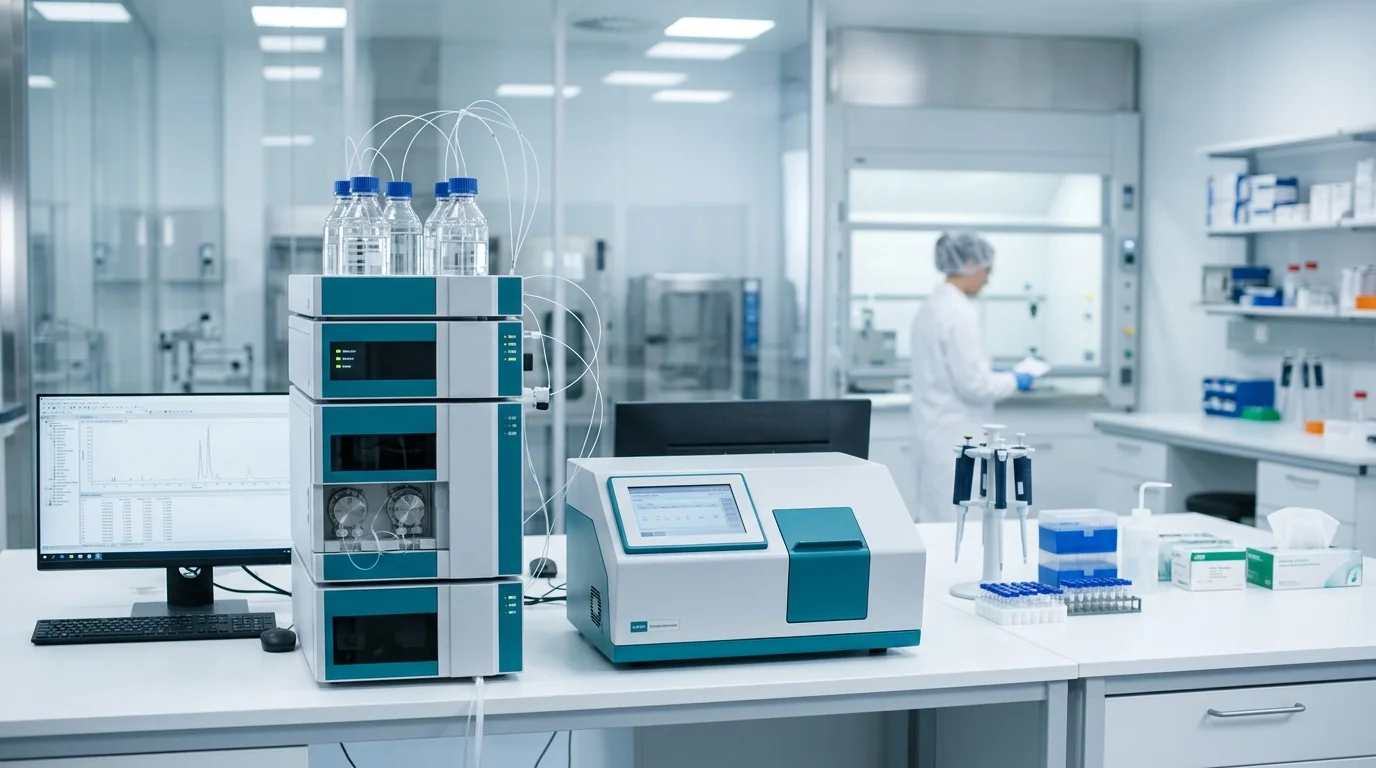
Pharmaceutical Tests And The Equipment We Supply
Use the table to find the relevant range quickly. Each row is explained below, including the points where a configuration has to be confirmed before you specify it.
| QC Or Utility Requirement | What We Supply | Brand Or Range |
|---|---|---|
| Specific optical rotation (USP <781>, Ph. Eur. 2.2.7) | Automatic polarimeters with controlled sample temperature, quartz control plates | Rudolph Research |
| Specific gravity and density (USP <841>), refractive index | Oscillating-tube density meters, automatic refractometers | Rudolph Research |
| Assay, related substances and stability samples | HPLC in gradient and isocratic configurations | Wayeal |
| Residual solvents and volatile impurities | Gas chromatography with FID | Wayeal |
| Impurity identification and confirmatory work | LC-MS and GC-MS | Wayeal |
| Specific elements where an AAS method is validated | Atomic absorption spectrophotometers | Wayeal |
| Water content and nitrogen (USP <461>) | Karl Fischer titrators; Kjeldahl digestion and distillation | Laboratory range; VELP Scientifica |
| Chlorine removal and hardness ahead of RO | Continuous chlorine analyser, hardness measurement | HACH |
| Purified water conductivity and TOC | Online and laboratory conductivity and TOC measurement | HACH and process instrument range |
| Microbial control, ozone and TOC reduction in water loops | Aquafine UV systems | Trojan Technologies |
| Microbial limits, water counts, sterility support and environmental monitoring | TSA, Sabouraud dextrose, R2A, Cetrimide and thioglycollate media, contact plate agar | Biokar Diagnostics |
| Incubation, sterilization and aseptic handling | Incubators, autoclaves, hot-air ovens, laminar flow and biosafety cabinets | Zenithlab; laboratory range |
| Plant effluent pretreatment | Coagulants and flocculants | Bluwat |
Documentation, Installation And Local Support For GMP Laboratories
In a GMP laboratory an instrument arrives with obligations. It has to be installed, qualified, calibrated against traceable standards and documented before it produces its first reportable result. Our engineers install and commission the instruments described here and train the analysts who will use them. Rudolph polarimeters and density meters are installed, calibrated and handed over on site with NIST-traceable calibration standards and quartz plates, and Wayeal HPLC and GC systems, which we distribute exclusively in Pakistan, are commissioned by factory-trained engineers.
Consumables come with paperwork too. Biokar media arrive with certificates of analysis and are handled with attention to the cold chain, HACH reagents and consumables are stocked in Pakistan, and batch documents, analysis certificates and calibration certificates are supplied for your quality files. Qualification documents such as IQ and OQ protocols differ by manufacturer and model, so ask which documents come with a specific instrument before the purchase order is raised. The scope of that support is set out under our installation, calibration and training services.
Pharmacopoeial Physical Tests: Optical Rotation, Density And Refractive Index
Physical constants are among the fastest identity and purity checks on incoming materials and finished products, and the pharmacopoeias are specific about how they are measured. USP <781> sets optical rotation at the sodium D line and 25 ± 0.5 °C, Ph. Eur. 2.2.7 works at 20 ± 0.5 °C, and both expect calibration traceable to national standards. Because optical rotation moves with temperature, a polarimeter without controlled sample temperature cannot reliably hold a monograph limit.
Rudolph Research Autopol automatic polarimeters are built around that requirement. Rudolph positions the Autopol V Plus and Autopol VI for pharmacopoeial work, with Peltier sample temperature control, multi-wavelength verification and support for 21 CFR Part 11 electronic records, and quartz control plates provide the traceable check before each analytical series. Model selection and accessories are covered on our Rudolph Research polarimeter and density meter page.
For liquids, USP <841> allows specific gravity by pycnometer or by an oscillating transducer density meter, at 25 °C unless the monograph states otherwise. Rudolph DDM automatic density meters take the second route and include VideoView bubble detection, because a trapped bubble is a common cause of a wrong density reading. Refractive index for oils, solvents and syrup-based materials is measured on the J Series automatic refractometers.
Chromatography For Assay, Impurities And Residual Solvents
HPLC carries most of the analytical workload in a finished-dosage QC laboratory: assay and related substances at release, the same tests at each stability time point, and the validation work behind a registration dossier. Wayeal LC3200 series HPLC systems are supplied in gradient and isocratic configurations for this work, and the Wayeal chromatography and spectroscopy range extends it to the GC6100 gas chromatograph with FID for residual solvents, and to LC-MS (TQ9200) and GC-MS (GM6100) where an impurity has to be identified rather than only quantified.
Two questions deserve an answer before purchase. The first is data integrity: confirm that the chromatography software’s audit trail, user access levels and electronic records meet your own data integrity procedure, and ask for the manufacturer documentation that supports the assessment. The second is method fit: residual solvent methods under ICH Q3C are normally run by static headspace GC, so specify the headspace sampler together with the GC rather than assuming it.
Metals need the same care. ICH Q3D and USP <232> and <233> moved elemental impurities to a risk-based approach; USP <233> describes ICP-OES and ICP-MS procedures and accepts alternative procedures that meet its validation requirements. Wayeal lists its atomic absorption instruments for heavy metals in pharmaceutical samples, and AAS suits laboratories whose risk assessment calls for a few specific elements with a method validated to the required limits. It is not a like-for-like replacement for a multi-element ICP-MS screen.
Water For Pharmaceutical Use: Pretreatment, Purified Water And The Loop
Purified water is usually the highest-volume material a pharmaceutical plant uses and one of the utilities most closely examined at inspection. A typical system pretreats groundwater or municipal supply through multimedia filtration, softening and activated carbon, produces purified water by reverse osmosis, often followed by EDI, and then stores and recirculates it through a distribution loop. WHO guidance on water for pharmaceutical use expects the critical parameters of that system to be monitored, and continuous measurement is the practical way to do it at the control points.
Pretreatment protects the membranes. Polyamide RO membranes do not tolerate chlorine, so residual chlorine after the carbon filter is a control point in its own right, and the CL17sc continuous chlorine analyser from our HACH water analysis range confirms removal before the water reaches the RO. Hardness after the softener shows when regeneration is overdue, before scale forms on the membrane surface.
Release parameters follow the RO and EDI. Ph. Eur. limits purified water in bulk to a conductivity of 5.1 µS/cm at 25 °C and TOC of 0.5 mg/L; USP <645> applies a staged conductivity test and USP <643> a TOC test with system suitability. Conductivity and TOC measured continuously at the generation outlet and the loop return turn those limits into a running record. HACH states that its conductivity solution complies with USP <645>, and TOC and conductivity monitoring for purified and high-purity water sit within our online instruments for purified water systems. Confirm the TOC analyser model and its USP <643> system suitability arrangement for your loop when you enquire, since that configuration decides whether the record supports release.
In the loop itself, UV does three jobs. Aquafine UV systems, a Trojan Technologies brand, are used in USP and WFI applications for microbial inactivation and for reducing ozone, TOC and chlorine or chloramine. Where a loop is sanitised with ozone, UV removes the residual ahead of the points of use, and an online ozone measurement confirms it has gone. Trojan and Aquafine UV systems are sized on flow rate, UV transmittance and the duty required.
Microbial quality is the remaining attribute, and it cannot be measured online. Ph. Eur. counts purified water on R2A agar at 30 to 35 °C for at least five days, with an action level of 100 CFU/mL. Biokar R2A agar is intended for enumerating viable aerobic microorganisms in treated water, including purified water and water for injectable preparations. We supply the measurement, UV and microbiology for a water system; the RO, EDI, distillation and loop hardware come from the system builder, and endotoxin testing of WFI is outside our range.
Microbiology: Microbial Limits, Sterility Support And Environmental Monitoring
Non-sterile products are tested for microbial enumeration and specified organisms under USP <61> and <62>, harmonised with Ph. Eur. 2.6.12 and 2.6.13, and the pharmacopoeia is explicit about media: each batch of ready-prepared medium, and each batch prepared from dehydrated medium, has to pass a growth promotion test before use. Media choice therefore affects the laboratory’s workload as well as its results. A certificate of analysis supports your file but does not replace your own growth promotion testing.
Biokar Diagnostics media for pharmaceutical microbiology include Trypto-Casein Soy Agar (TSA) in dehydrated, ready-to-melt and ready-to-use plate formats, Sabouraud dextrose agar for yeasts and moulds, Cetrimide agar for Pseudomonas aeruginosa, and thioglycollate medium with resazurin for sterility-support work. Contact plate agar, supplied as dehydrated medium, is intended for surfaces, equipment and personnel monitoring, and Biokar also lists it for air control.
For sterile manufacturers, environmental monitoring is shaped by the revised Annex 1 published by the EU in 2022 and adopted by PIC/S. Its action limits for viable contamination are no growth in Grade A, 5 CFU per settle plate and per contact plate in Grade B, and 100 CFU per settle plate in Grade D. A programme at that level depends on plates that recover consistently and on incubators that hold temperature through a Pakistani summer.
Zenithlab bacteriological incubators, autoclaves and hot-air ovens cover incubation and media preparation, and colony counters, membrane filtration manifolds, biosafety cabinets and laminar flow cabinets come from our laboratory equipment and supplies range. Sterility test isolators are outside the range.
Raw Material Tests And Cleaning Validation
Several routine tests sit outside the headline instruments but hold up release when they fail. Water content by Karl Fischer titration appears in many API and excipient monographs, and Karl Fischer titrators are part of our laboratory range. Where a monograph calls for nitrogen determination under USP <461>, a Kjeldahl digestion followed by distillation and titration, VELP Scientifica digestion and distillation units run the method, and KjTabs and other VELP consumables are kept in Pakistan. Analytical balances, pH meters and conductivity meters complete the bench.
Cleaning validation draws on the same instruments. After a product changeover, residues on shared equipment have to be shown to be below the acceptance limit: product-specific residues are usually measured by HPLC on swab or rinse samples, TOC gives a fast non-specific measure on rinse samples where it has been justified for the residue concerned, and conductivity confirms that detergent has been rinsed away. A laboratory TOC analyser is listed in our range; confirm the model against your recovery study before specifying it.
Effluent From Formulation And API Plants
Pharmaceutical effluent varies sharply by plant type. A formulation plant discharges washings from granulation, coating and equipment cleaning, carrying suspended excipients, coating pigments and dissolved actives at moderate volume. An API plant adds solvents and synthesis residues, with a higher and less biodegradable COD.
Coagulation and flocculation is used as a pretreatment step on pharmaceutical wastewater to take out suspended solids, colloids and part of the COD before biological treatment. It does not remove dissolved actives or solvents, which need biological or advanced oxidation stages. For the pretreatment duty, Bluwat coagulants and flocculants, including polyaluminium chloride, ferric sulphate, PolyDADMAC and polyacrylamide grades, are selected after a jar test on a sample of your own effluent, and COD and BOD are verified with HACH or VELP laboratory methods.
Pharmaceutical Manufacturers Across Pakistan: How We Support You
TDAP counted 759 pharmaceutical manufacturing units in 2019, with 440 in Punjab, 183 in Sindh and 114 in Khyber Pakhtunkhwa, and identified Karachi as the leader on production volume, with Lahore and Peshawar as the other main hubs. Manufacturers in Sindh deal with our Karachi team, while Punjab manufacturers are served by our Lahore corporate office. The two offices together support supply and technical service for units elsewhere, including Peshawar and Islamabad–Rawalpindi; there is no Khan Associates office in Khyber Pakhtunkhwa, so state the site address in your enquiry and site visits will be scheduled around it.
Timing is the practical point. With DRAP implementing PIC/S GMP in phases and joining the International Pharmaceutical Regulators Programme in June 2026, more of a QC laboratory’s evidence will be judged against international expectations. Plan instrument purchases so that installation, calibration and training records exist before the relevant inspection or registration submission, not after it.
What To Include In An Instrument, Media Or Water-Monitoring Enquiry
- ✔The test and its reference: the monograph or general chapter (USP, BP or Ph. Eur.) and any in-house method you follow.
- ✔Samples and expected range: API, excipient or finished product, and the values or limits involved.
- ✔For chromatography: the methods to be run, detectors required, samples per day and your data integrity requirements.
- ✔For a water system: generation route, flow rate, loop temperature and sanitisation method, existing instruments and sample points.
- ✔For microbiology: the tests you run, target organisms, monthly media use, prepared or ready-to-use preference, and incubation capacity.
- ✔Existing equipment and the qualification documents you will need with a new instrument.
- ✔Site location and timeline, including any inspection or registration date the purchase has to meet.
Dissolution, disintegration, hardness and friability testers, endotoxin (LAL) reagents, pharmaceutical water generation plants, and APIs or excipients are outside our supply range. Humidity chambers are listed in our laboratory range, but their suitability for ICH stability storage has to be confirmed for the specific unit.
Pharmaceutical QC And Water System FAQs
Is A Rudolph Autopol Polarimeter Suitable For USP <781> And Ph. Eur. 2.2.7 Testing?
Rudolph positions the Autopol V Plus and Autopol VI for pharmacopoeial work, with measurement at the sodium D line, Peltier temperature control and traceable quartz control plates. Your laboratory still qualifies the instrument under its own procedure and verifies temperature during qualification.
Can A Density Meter Replace The Pycnometer For Specific Gravity?
Yes, where the monograph follows USP <841>, which allows either a pycnometer or an oscillating transducer density meter. Measure at the temperature the monograph specifies, 25 °C unless stated otherwise, and use bubble detection to avoid the most avoidable source of error.
Which HPLC Configuration Do We Need For Assay And Related Substances?
It depends on your methods. Most related substances methods run gradient separations, while many assays are isocratic. Send the methods you run and your daily sample numbers, and we will configure the Wayeal system around them, including the detector and column oven requirements the methods specify.
Can We Use AAS For Elemental Impurities Under ICH Q3D?
For specific elements, where your risk assessment identifies them and the AAS method has been validated to the required limits, yes. USP <233> describes ICP-OES and ICP-MS but accepts alternative procedures that meet its validation requirements. For a broad multi-element screen, ICP-MS remains the usual route.
What Online Instruments Does A Purified Water Loop Need?
At minimum, conductivity and TOC at the generation outlet and the loop return. Chlorine measurement after the carbon filter protects the RO membranes, and an ozone measurement belongs downstream of UV on an ozonated loop. Microbial counts on R2A are sampled separately, because they cannot be measured online.
Do You Supply Media For Growth Promotion Testing?
We supply the media, with certificates of analysis. Growth promotion testing itself is run by your laboratory with reference strains from a recognised culture collection, and it applies to every batch of medium you use.
Do You Supply Dissolution Testers Or Stability Chambers?
Dissolution and other tablet testing equipment is not in our range. Humidity chambers are listed in our laboratory range, but whether a specific unit suits ICH stability storage, including its temperature and humidity mapping, has to be confirmed before you specify it.
Does DRAP Require Particular Instrument Brands?
No. GMP inspection examines whether an instrument is qualified, calibrated and controlled, whether its data are reliable and whether the method is validated, rather than which brand you bought. The brand matters only in so far as it lets you meet those requirements.
Can You Install Instruments And Train Our Analysts On Site?
Yes. Installation, commissioning and analyst training are provided for the polarimeters, density meters, chromatography systems and water analysers described above, from Lahore and Karachi. For sites outside Punjab and Sindh, give us the location and timeline when you enquire.
Ask For A Configuration And Quotation
Tell us the tests and methods you need to run, the samples and volumes involved and the equipment you already own, and our reply will set out a recommended configuration and a formal quotation, and will say plainly if part of the requirement falls outside our range. For a water system, include a sketch of the loop and its sample points; for microbiology, your monthly media use. Use the enquiry form, email or call either office, or message us on WhatsApp.