


Water Chemistry And Flow Measurement For Power Plants In Pakistan
Power plant water analysis in Pakistan, together with flow measurement for water, steam and fuel gas and the coagulant chemistry that protects the DM and RO plant, is what Khan Associates supplies to coal, RLNG, engine-based and captive power plants, with Karachi supporting the coastal units and Lahore the Punjab fleet.
The application that has changed most is chemistry monitoring on units that now cycle. Supercritical coal units at Sahiwal and Port Qasim and the RLNG combined-cycle plants in Punjab start, stop and two-shift under merit-order dispatch, and every start sends the dirtiest water in the cycle into the boiler. Send us your panel scope for a recommendation and a quotation.
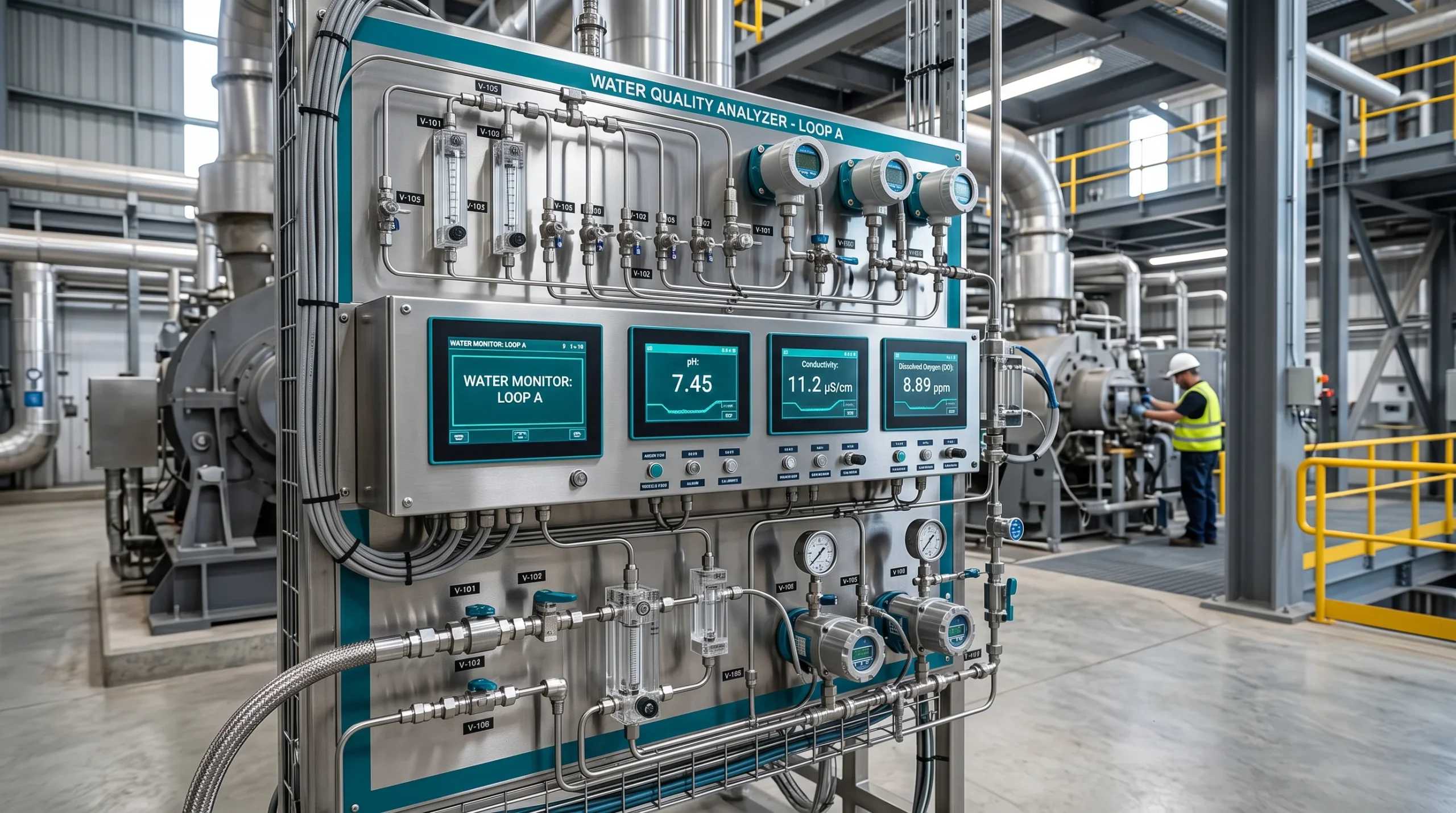
Power Plant Duties And Supplied Instruments
The final row matters as much as the others: it lists the steam-cycle measurements to confirm with us before a sample panel is specified.
| Plant Duty | Instrument Or Chemistry Supplied | Brand |
|---|---|---|
| Feedwater and condensate DO, pH and conductivity | Online DO, pH and conductivity sensors on sc digital controllers | HACH |
| Boiler water phosphate and laboratory checks | DR series spectrophotometers with reagent chemistry | HACH |
| Portable verification of online readings | HQ series meters with IntelliCAL probes | HACH |
| Seawater once-through chlorination | CL17sc continuous chlorine analyser | HACH |
| Cooling tower cycles of concentration | Conductivity, hardness, alkalinity and silica measurement | HACH |
| Clarifier outlet turbidity | TU5 laser turbidimeters | HACH |
| Raw water clarification ahead of DM and RO | Polyaluminium chloride, aluminium chlorohydrate, ferric sulphate, polyacrylamide | Bluwat |
| Fuel gas and steam flow for heat rate | V-Cone differential pressure meters, ExactSteam energy metering | McCrometer |
| Cooling water flow without an outage | FPI Mag hot-tap insertion meters, Ultra Mag and Dura Mag full-bore meters | McCrometer |
| Condenser leak investigation and corrosion products | Ion chromatography, atomic absorption | Wayeal |
| Continuous sodium, silica and cation conductivity | Confirm availability and configuration before specifying | Ask us |
Instrument Service, Calibration And Spares
An online analyser that has drifted is worse than no analyser, because it is trusted. Reagent-based instruments need reagent continuity, probes need calibration, and both need someone able to attend site.
For a sample panel, that means installation and commissioning by our engineers, scheduled calibration and technical support, reagent and spares planning, and operator training, all set out in our services. Reagents, probes and routine spares for the panel are stocked locally rather than imported per order, calibration is documented for your plant records, and instruments are covered by manufacturer warranty. Khan Associates has supported process instrumentation in Pakistan since 1994. For a plant carrying a full sample panel, the maintenance and consumable plan is part of the specification decision and not an afterthought.
Where A Power Plant Actually Loses Money On Water And Flow
Three failure routes, and they are rarely owned by the same person.
Chemistry excursions damage capital equipment. Silica carries over into steam and deposits on turbine blading. Dissolved oxygen and the wrong pH drive corrosion in feedwater heaters and economisers. Chloride and sulphate ingress from a condenser leak attacks boiler tubes. None of these announce themselves on the day; they are cumulative, and the cost appears at the next outage.
Unmeasured flows mean an unknown heat rate. If fuel gas, steam and feedwater flows are not measured accurately, efficiency is an estimate. For a plant dispatched on merit order, where a fraction of a percentage point in heat rate changes where you sit in the stack, that estimate is a commercial exposure.
Cooling system fouling costs output continuously. Condenser fouling raises backpressure and cuts output every hour it persists, and it is usually detected late because nobody is measuring the parameters that predict it.
Steam Cycle Chemistry: What The Cycle Actually Demands
The purity requirement in a modern steam cycle is severe, and it tightens as pressure rises.
Feedwater And Condensate
The controlling concerns are dissolved oxygen, pH, and the ingress of contaminants through the condenser. Oxygen drives corrosion of carbon steel in feedwater heaters and economisers, and it also mobilises iron that then deposits where you least want it. Cation conductivity is the standard early warning of anion ingress, because it strips the treatment amine and leaves the contaminant signal visible. Condensate returning from a leaking condenser — particularly one cooled with seawater — carries chloride, and chloride in a high-pressure boiler is a tube-failure mechanism rather than a housekeeping issue.
Boiler Water
Drum units run a controlled treatment regime with phosphate or an all-volatile chemistry, and the boiler water is managed by blowdown against conductivity and silica. Once-through and supercritical units have no drum, therefore no blowdown, and therefore no means of correcting a contaminant once it is in the cycle. Whatever enters, passes through. That is why Pakistan’s supercritical coal units at Sahiwal and Port Qasim operate to tighter chemistry limits than the older subcritical fleet, and why their monitoring requirement is genuinely different rather than simply more of the same.
Steam Purity And The Turbine
Silica is the parameter that reaches the turbine. It volatilises and carries over with steam at high pressure, then deposits on blading, reducing efficiency and, in the worst case, unbalancing the machine. Sodium is the companion indicator of carryover. These two parameters are the reason steam purity is monitored continuously rather than by grab sample.
Cycling Duty Changes Your Chemistry Risk
Cycling is the live chemistry issue for Pakistani thermal plants, and it is rarely addressed in monitoring specifications written for baseload.
Much of the fleet — RLNG combined-cycle units at Bhikki, Haveli Bahadur Shah, Balloki and Jhang, and coal units running against hydel seasonality — was conceived for steady operation and now runs on merit order. Plants two-shift, start and stop, and sit idle for periods. Cycling changes the chemistry risk profile in ways that a baseload monitoring philosophy does not cover.
Air in-leakage rises during low-load and shutdown conditions, bringing oxygen into a cycle designed to exclude it. Layup between runs becomes a chemistry problem in its own right, because an unprotected boiler corrodes while it is doing nothing. Startups mobilise accumulated corrosion products, so the dirtiest water in the cycle is the water entering the boiler immediately after a start — exactly when operators are busiest and least likely to be watching chemistry. On a combined-cycle plant, each HRSG pressure level behaves differently through a start.
The practical consequence for instrumentation is that continuous monitoring matters more on a cycling plant than on a baseload one, not less, and that startup chemistry is the period worth instrumenting properly. If your plant’s dispatch pattern has changed since commissioning and your monitoring has not, that gap is worth reviewing.
What We Can Monitor, And What To Confirm Before Specifying A Panel
Being precise here, because a steam cycle sample panel is a significant specification and vague supplier claims cause trouble at commissioning.
Verified in our HACH range for this application: dissolved oxygen probes, pH, conductivity, phosphate, turbidity including TU5 laser turbidimeters, continuous chlorine analysis via the CL17sc, and the sc series digital controllers that tie continuous measurement into plant control. The HACH brand page also names power plants directly for boiler feedwater and cooling water chemistry, including silica, hardness and dissolved oxygen. Laboratory determination is covered by DR series spectrophotometers with reagent chemistry, and portable verification by HQ series meters with IntelliCAL probes. The HACH sc platform ties these into plant control; see our online analysers and sample panel instrumentation for the wider platform.
Confirm with us before you specify: dedicated continuous sodium analysers, dedicated continuous silica analysers, and cation conductivity measurement. These are standard components of a full steam-cycle panel, and availability and configuration depend on your sample conditions, so confirm them before you specify. Tell us the panel scope you need and we will come back with what can be supplied and what cannot.
That distinction matters more on a supercritical unit, where sodium and silica are not optional parameters.
Cooling Water: Seawater Once-Through And Recirculating Towers
Two very different problems, depending on where the plant sits.
Coastal plants at Port Qasim, Bin Qasim and Hub run large once-through seawater circuits. The controlling issues are biofouling of condenser tubes and control of the chlorination used to prevent it. Under-dose and you foul the condenser, losing vacuum and output; over-dose and you have a residual at the outfall that is both wasteful and an environmental exposure. That is a continuous measurement problem, and the CL17sc continuous chlorine analyser is the instrument built for it.
Inland plants run recirculating cooling towers, where the controlling variable is cycles of concentration. Running more cycles saves make-up water and blowdown but concentrates hardness, alkalinity and silica toward their scaling limits. Conductivity is the practical control parameter, with hardness, alkalinity, silica and chlorine tracked alongside it. This is a measurement and control problem first; the inhibitor programme that sits on top of it is a separate purchase, covered under cooling and boiler water chemicals.
Raw Water Clarification Ahead Of DM And RO
The water arriving at a Pakistani thermal plant is rarely clean. Sahiwal alone draws in the order of 60,000 cubic metres a day from the Lower Bari Doab Canal, and canal and river water carries a silt and turbidity load that varies with season and with upstream conditions.
Everything downstream depends on getting that load out. Turbidity and suspended solids reaching a demineralisation plant foul resin and shorten run lengths between regenerations; reaching an RO train, they foul membranes and raise differential pressure. Clarification is therefore not a peripheral duty — it protects the most expensive consumables on site.
We supply the coagulant and flocculant chemistry for this stage through Bluwat, covering spray-dried polyaluminium chloride, aluminium chlorohydrate, ferric sulphate and polyacrylamide flocculant grades. Because raw water quality moves with the season, dose optimisation is done by jar testing on your actual intake water rather than by carrying over a figure from commissioning. Turbidity monitoring on the clarifier outlet closes the loop.
Flow Measurement: Feedwater, Cooling Water And Fuel Gas
Flow measurement in a power plant is an accounting instrument as much as a process one, and the McCrometer range covers the three duties that matter.
The V-Cone differential pressure meter handles liquid, steam and gas, with built-in flow conditioning that holds accuracy where straight pipe runs are short — which describes most plant piping and every metering skid. It is used for natural gas measurement and power generation duties where conventional DP meters struggle, and the ExactSteam configuration provides complete steam energy metering. For an RLNG plant, fuel gas metering accuracy feeds directly into heat rate, and heat rate feeds into dispatch economics and tariff accounting.
For cooling water and auxiliary circuits, full-bore Ultra Mag and Dura Mag meters cover new installations, while the FPI Mag full-profile insertion meter installs through a hot tap without shutting down the line, dewatering or cutting pipe, at 0.5 percent accuracy on line sizes up to 138 inches. On a running plant where an outage window is scarce and expensive, the ability to add measurement without a shutdown is often the deciding factor rather than a convenience.
One detail that matters for anyone doing heat-rate work: McCrometer meters are supplied with NIST traceable calibration from ISO 17025 accredited flow laboratories. A performance test is only as defensible as the calibration behind its instruments. That traceability comes with every McCrometer meter, sized to your line conditions.
Trace Anions In High-Purity Water
Where a condenser leak is suspected, or where a plant needs to characterise ingress rather than simply detect it, ion chromatography resolves the individual anions — chloride and sulphate in particular — that cation conductivity only flags in aggregate.
This is a laboratory capability rather than an online one, and it suits plants with a properly staffed chemistry laboratory and a real investigation requirement. Wayeal ion chromatography systems cover anion and cation analysis in process samples, and atomic absorption covers metals work where corrosion product transport is being investigated. A plant chemistry laboratory can be equipped around the IC rather than piecemeal.
Plant Effluent, Coal Yard And Ash Handling Water
Coagulant chemistry fits some of these streams and not others.
Where it fits: coal pile runoff and ash handling water at the coal fleet, which carry a heavy suspended solids load and respond well to coagulation and settling. Also clarifier and settling pond duty generally.
Where it does not: demineralisation plant regeneration waste is an acid and caustic neutralisation problem, controlled on pH, not a coagulation problem. Cooling tower blowdown is dominated by dissolved salts, and coagulation does not remove dissolved solids. Oily water from turbine and transformer areas needs separation before any chemical step. Selling coagulant into those streams would not solve them.
For the streams where it does apply, we would propose coagulants and flocculants for coal yard water, and discharge parameters are verified with the same laboratory instrumentation described above.
Coastal And Inland Plants: Which Office Supports You
Coastal plants at Port Qasim, Bin Qasim and Hub, and the coal units in Sindh, fall to our Karachi team. Sahiwal, the RLNG plants at Bhikki, Haveli Bahadur Shah, Balloki and Jhang, and captive power across Punjab are handled from our Lahore office.
On a running plant the constraint is rarely distance; it is the outage window. Tell us your next planned outage when you enquire, so that panel work, probe replacement and full-bore meter installation can be scheduled into it, and ask about hot-tap insertion metering for lines where no window is coming.
Scoping A Sample Panel Or Flow Meter
- ✔Plant type and cycle: coal subcritical or supercritical, RLNG combined cycle, engine-based, or captive. For combined cycle, the number of HRSG pressure levels.
- ✔Your current dispatch pattern — baseload, two-shifting, or seasonal — and whether it has changed since commissioning.
- ✔Existing chemistry monitoring: which parameters are online, which are grab sample, and what the sample panel currently carries.
- ✔Cooling system type: once-through seawater, recirculating tower, or air cooled, with the source water and current cycles of concentration.
- ✔Raw water source and a recent analysis, including turbidity range across the year if you have it.
- ✔For flow measurement: line size, fluid (water, steam or gas), pressure and temperature, available straight run, and whether the line can be shut down for installation.
- ✔What problem you are chasing, if any — a suspected condenser leak, rising condenser backpressure, unexplained iron in feedwater, or a heat rate that does not reconcile.
Ion exchange resin, RO membranes, DM and RO plant, condensate polishing vessels and contracted treatment programmes are supplied by others; they are not part of our offer.
Power Plant Water And Flow FAQs
Our Unit Is Supercritical. Why Do The Chemistry Limits Differ From Our Older Plant?
Because a once-through or supercritical unit has no steam drum and therefore no blowdown. On a drum boiler you can correct a contaminant by blowing down; on a once-through unit, whatever enters the cycle passes through it and reaches the turbine. That removes your correction mechanism, which is why the purity requirement upstream is tighter and why continuous monitoring is not optional.
We Have Started Two-Shifting. Does That Change Our Water Chemistry Monitoring?
Yes, and usually in the direction of needing more rather than less. Air in-leakage rises at low load and during shutdown, layup between runs becomes a corrosion exposure, and startups mobilise accumulated corrosion products so the water entering the boiler just after a start is the dirtiest in the cycle. If your monitoring philosophy was set for baseload operation and your dispatch has changed, it is worth reviewing.
Do You Supply Online Sodium And Silica Analysers?
Ask us directly for your specific case. Silica, hardness and dissolved oxygen are named as power plant parameters in our HACH range, and dissolved oxygen, pH, conductivity, phosphate, turbidity and chlorine instrumentation are confirmed. For dedicated continuous sodium and silica analysers and cation conductivity, confirm configuration against your sample conditions before specifying, so a gap does not surface at commissioning.
How Do We Control Chlorination On A Seawater Once-Through System?
Continuously, on measured residual rather than on a fixed dose. Under-dosing fouls the condenser and costs output through raised backpressure; over-dosing wastes chemical and leaves a residual at the outfall. A continuous chlorine analyser such as the CL17sc is the instrument for this duty.
Can We Add A Flow Meter Without Taking An Outage?
On suitable lines, yes. The FPI Mag insertion meter is designed for hot-tap installation on a live line without dewatering, cutting or welding. Whether it suits depends on line size, fluid, pressure and access, so send us the line details and we will confirm.
Why Does Our DM Plant Need Regeneration More Often Than It Used To?
Most often because the load reaching it has increased, which usually traces back to raw water quality and clarification performance rather than to the resin itself. Seasonal turbidity changes in canal and river water are a common cause. Check clarifier performance and coagulant dose before assuming a resin problem.
Do You Supply Boiler And Cooling Water Treatment Chemicals?
Treatment chemistry is a separate line in our portfolio. What we supply for the cycle itself is the measurement that tells you whether any programme is working, plus the coagulant chemistry ahead of your DM and RO plant. We are not a treatment service contractor and do not present ourselves as one.
Does Coagulant Chemistry Help Our Cooling Tower Blowdown Or DM Regeneration Waste?
Generally no. Blowdown is dominated by dissolved salts and coagulation does not remove dissolved solids. DM regeneration waste is an acid and caustic neutralisation problem controlled on pH. Coagulation genuinely helps coal pile runoff, ash handling water and clarifier duty, and those are the streams where we would propose it.
Request A Recommendation For Your Unit
Send us your plant type, your current monitoring scope and the specific problem you are working on, and we will come back with an instrument and chemistry recommendation, a formal quotation, and a clear statement of anything outside what we supply. The contact page reaches both offices; phone and WhatsApp work as well.
Khan Associates
Lahore Corporate Office:
184 S, Quaid-e-Azam Industrial Estate, Kot Lakhpat, Lahore, Pakistan.
+92-42-35146680-83
Karachi Office:
908-909, 9th Floor, Portway Trade Centre, Plot 189/A, S.M.C.H.S, Main Shahrah-e-Faisal, Karachi, Pakistan.
+92-21-34540251-52
khi@khanassociates.net
WhatsApp: +92 301 4168242, 9:00am to 5:00pm
Email: info@khanassociates.net