


Equipment For Third Party Testing And Research Laboratories In Pakistan
For testing laboratory equipment in Pakistan, third-party and contract laboratories, university and research laboratories, and laboratories preparing for ISO/IEC 17025 can source analytical instruments, culture media, reagents, reference standards, general equipment and glassware from Khan Associates in Karachi and Lahore.
The central application is buying against a scope of accreditation rather than a wish list, because a commercial laboratory can only sell the tests it can validate, reproduce and defend to a PNAC assessor. The item-by-item laboratory supplies and instruments list covers the catalogue; send us your target scope and we will recommend a configuration with a quotation.
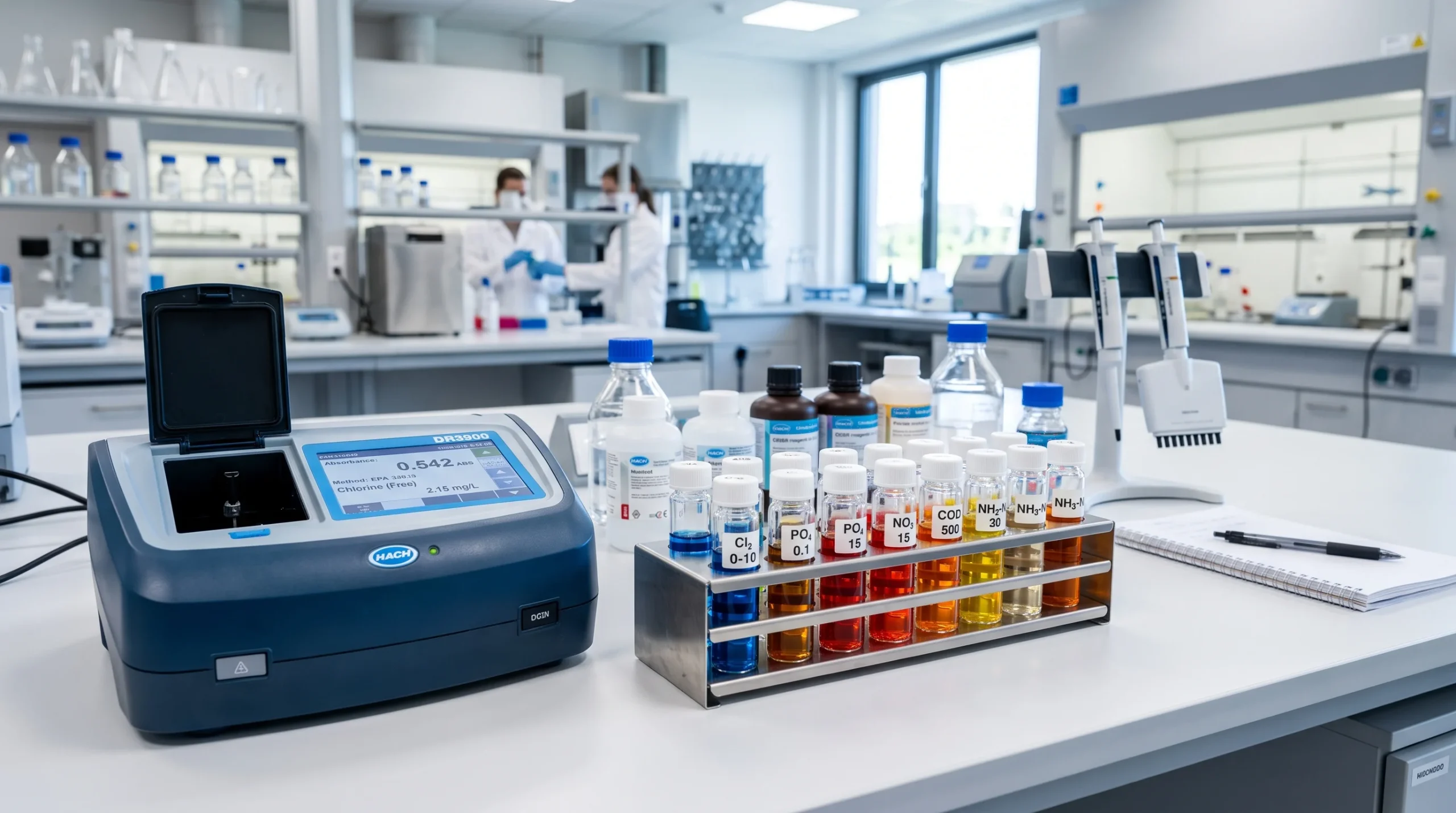
Scope Areas And The Equipment Behind Them
Organised by scope area rather than by product, because that is how an accredited laboratory plans its menu. How each area is validated and defended is covered below.
| Scope Area | Instruments And Consumables Supplied | Brand |
|---|---|---|
| Water and wastewater parameters | DR series spectrophotometers, TNTplus vial chemistry, DRB200 reactors, TU5 turbidimeters, HQ series meters | HACH |
| Trace metals | Atomic absorption spectrophotometers | Wayeal |
| Anions and cations | Ion chromatography systems | Wayeal |
| Organics, residues and actives | HPLC and gas chromatography | Wayeal |
| Protein and nitrogen | Kjeldahl digestion and distillation, Dumas combustion analysers | VELP Scientifica |
| Fat, fibre and oxidation stability | Solvent extractors, fibre analysers, OXITEST | VELP Scientifica |
| COD and BOD | ECO COD thermoreactors, respirometric BOD sensors | VELP Scientifica |
| Food and water microbiology, including certified rapid methods | Culture media, selective agars, NF VALIDATION certified alternative methods | Biokar Diagnostics |
| Optical rotation, Brix, density and refractive index | Autopol polarimeters, J Series refractometers, DDM density meters, traceable standards | Rudolph Research |
| Incubation, sterilisation and drying | Incubators, autoclaves, drying and vacuum ovens | Zenithlab |
Calibration, Traceability And Service
An accredited laboratory cannot treat instrument upkeep as reactive maintenance. Calibration status, traceability and the control of measuring equipment are part of what an assessor examines, and an instrument out of calibration puts results issued in the interim in question.
Installation and commissioning, method configuration on site, calibration and technical support, and operator training are available through our services. For an accredited laboratory the paperwork counts for as much as the site visit: calibration certificates go into your equipment files, warranty sits with the manufacturer, and consumables and routine spares are kept in stock in Pakistan so a sample backlog is never held up by an import cycle. For a laboratory planning an accreditation application or a surveillance assessment, it is worth building the calibration and consumable plan into the purchase decision rather than after it.
Your Product Is The Result
Every other laboratory we supply exists to serve a production line. If a plant laboratory produces a wrong number, a batch is affected and the plant corrects it internally. A third-party laboratory that produces a wrong number has shipped a defective product to a client who relied on it, and may have to explain it to an assessor.
That difference reshapes the purchasing logic. A plant laboratory buys the instrument that measures its own product. A testing laboratory buys capability it can defend: a method it can validate, a result it can reproduce, a calibration it can trace, and a performance it can demonstrate in a proficiency testing round. The instrument is the smallest part of that.
It also changes the economics. For a plant laboratory, a test is a cost. For a commercial laboratory, a test is revenue, and an instrument that adds a test to the menu pays for itself in sample throughput. That is why the right question is rarely “which instrument is best” and almost always “what will this let us offer, and what will it take to be allowed to offer it”.
Buying Against Your Scope Of Accreditation
Accreditation in Pakistan runs through the Pakistan National Accreditation Council, which accredits testing and calibration laboratories to ISO/IEC 17025, medical laboratories to ISO 15189, and proficiency testing providers to ISO/IEC 17043. PNAC is a member of the ILAC and APLAC mutual recognition arrangements, which is the commercial point of the whole exercise: an accredited report is recognised across the economies covered by those arrangements, so accreditation is what converts a local test report into one an overseas buyer will accept.
The detail that governs purchasing is this: you are not accredited as a laboratory. You are accredited for specific tests, on specific matrices, by specific methods. Adding a test means extending your scope, and a scope extension carries obligations that arrive with the instrument.
- ✔Method validation. PNAC maintains a policy on method validation. A new method on your scope has to be validated, not simply installed, and the instrument has to be capable of demonstrating the performance the method claims.
- ✔Proficiency testing. Under PNAC’s policy on participation in proficiency testing, applicant laboratories are expected to participate successfully in PT or an interlaboratory comparison before accreditation, and accredited laboratories submit PT results and corrective action responses. An instrument that cannot deliver reproducible results will surface in a PT round in front of the regulator.
- ✔Calibration and control of equipment. PNAC maintains specific requirements for the calibration and control of weighing machines and of thermometers for accredited laboratories. Balances and temperature-controlled equipment are not background items on an accredited laboratory’s asset list; they are assessed.
The practical consequence when you are buying: work backwards from the scope you want to hold, to the methods that scope requires, to the instrument that can run those methods with the performance the method demands — and budget for the calibration, standards and PT participation alongside the instrument, not after it. When you send us an enquiry, telling us the method and the scope you are targeting gets you a better answer than telling us the instrument you had in mind.
Water And Wastewater Testing
For most Pakistani commercial laboratories this is the volume work: drinking water against national and WHO-referenced parameters, bottled water, industrial effluent against NEQS discharge parameters, groundwater, and surface water for consultants and research programmes.
The instrument backbone is photometric. A laboratory spectrophotometer with a digestion reactor and a reagent system covers a wide parameter list from one platform, which for a commercial laboratory means one capital item supporting many menu items. HACH DR series spectrophotometers with TNTplus barcoded vial chemistry and DRB200 reactors are the common configuration, alongside TU5 laser turbidimetry, HQ series portable meters with IntelliCAL probes for pH, conductivity and dissolved oxygen, and water testing kits and standards.
One point that matters specifically for an accredited laboratory rather than a plant laboratory: pre-dosed barcoded reagent chemistry removes several manual preparation steps from the analysis. Fewer manual steps means fewer sources of between-analyst variation, and between-analyst variation is exactly what a proficiency testing round is designed to expose. Reagent format is a reproducibility decision, not only a convenience one.
Extending Scope Into Metals, Anions And Organics
The scope extensions that most often move a Pakistani laboratory up the value chain are trace metals, ion chromatography and chromatographic organics — heavy metals in water, food and soil; anions and cations in water; and separations work for residues and actives.
Cost is the real barrier here rather than capability. A laboratory that would extend its scope into heavy metals often cannot justify a European or Japanese atomic absorption spectrophotometer against its likely sample volume, and simply does not extend. Wayeal supplies atomic absorption, ion chromatography, HPLC and gas chromatography platforms at a cost that changes that calculation, and as the exclusive Wayeal distributor in Pakistan we install, commission, configure the method and train the operators locally. For a laboratory whose accreditation depends on demonstrating method performance, local commissioning and method setup is not an optional extra.
Be realistic about the scope of work this opens. An AAS extends you into metals. Mycotoxin and pesticide residue work at the levels importing authorities expect needs mass spectrometric detection, method validation and analyst experience beyond the instrument itself, and it is a strategic decision rather than an equipment purchase. Talk to us about the scope before selecting the platform.
Food, Feed And Environmental Analysis
Contract laboratories serving food processors, feed mills, flour mills and edible oil producers live on proximate analysis, and the same instruments serve environmental work.
VELP Scientifica covers the whole of it: DK and DKL digestion with UDK distillation for Kjeldahl nitrogen, protein, TVBN and ammoniacal nitrogen according to AOAC, ISO, EPA and DIN methods; NDA 701 and NDA 702 Dumas combustion analysers where throughput and operator safety matter; SER 148 and SER 158 solvent extractors for fat by the Randall method; crude and detergent fibre analysers alongside AOAC-compliant dietary fibre systems; OXITEST for oxidation stability to AOCS Cd 12c-16; and ECO COD thermoreactors with respirometric BOD sensors for the environmental side of the menu.
For a commercial laboratory the Kjeldahl-versus-Dumas decision usually resolves differently than it does for a plant laboratory. A plant runs one matrix and can match the official method for that product. A contract laboratory runs many matrices against many client specifications, so it often needs the reference method on the scope regardless of throughput, and adds Dumas for volume. Consumable continuity matters more too — genuine catalyst tablets and receiver formula held locally, because a contract laboratory with a backlog cannot wait on an import.
Microbiology, And The Rapid-Method Question
Microbiology is where a testing laboratory’s method choice gets examined most closely, because an alternative method has to be justified against the reference method it replaces.
We supply Biokar Diagnostics media as the authorized Pakistan distributor, covering dehydrated, ready-to-use and ready-to-melt culture media and diluents, selective agars including Baird-Parker, Bismuth Sulfite and Cetrimide, supplements and additives, and peptones and agar bases for laboratories preparing their own formulations. Biokar is the microbiology division of the Solabia group, which manufactures its own peptones, and that matters for a laboratory whose PT performance depends on media recovering consistently batch to batch.
The part worth understanding before you buy is the alternative-methods range: rapid and alternative methods certified under NF VALIDATION and ISO, including IRIS Salmonella, COMPASS Listeria, COMPASS Bacillus cereus, chromogenic coliform agar for E. coli and other coliforms, and methods for Salmonella and Cronobacter, Pseudomonas, and yeasts and moulds. A certified alternative method is what lets a laboratory shorten turnaround without having to defend an unvalidated shortcut, because the certification is the evidence that the alternative performs equivalently to the reference method. For a commercial laboratory competing on turnaround time, that is a commercial instrument as much as a technical one.
Water microbiology adds membrane filtration — manifold filtration assemblies and 0.45 micron membrane filters — plus colony counters and the incubation described below.
Polarimetry, Refractometry And Density
Optical measurement earns its place on a contract laboratory’s scope through specific client sectors rather than general demand.
Specific optical rotation is an identity and purity test in pharmacopoeial monographs, which matters to any laboratory serving pharmaceutical clients. Pol and Brix are the basis of sugar analysis under ICUMSA methods for laboratories serving sugar mills. Density, specific gravity and refractive index are routine raw material and product QC parameters for chemical and petroleum clients.
Rudolph Research covers all three: Autopol polarimeters and saccharimeters, J Series automatic refractometers, and DDM automatic density meters, with Brix calibration fluids and quartz control plates made to NIST and ICUMSA specifications from Rudolph’s own standards laboratory. For an accredited laboratory the traceable standards are not an accessory — they are how the measurement is defended.
The Infrastructure Nobody Budgets For
Laboratories being built or extended consistently under-budget the equipment that does not appear in the method but without which the method cannot run.
Incubation at multiple temperatures. Autoclaves for media and glassware. Laminar air flow and biosafety cabinets for aseptic handling. Drying and vacuum drying ovens, and a muffle furnace for ash work. Centrifuges. Analytical and general balances. Water baths, magnetic and overhead stirrers, ultrasonic baths, vacuum pumps, sieve shakers and moisture analysers. Colony counters and microscopes. Volumetric glassware, membrane filters, pipettes and consumables. Analytical grade and HPLC grade reagents, and primary and secondary standards.
Zenithlab covers much of the controlled-temperature and general equipment layer. Two of these items are assessed directly under PNAC requirements — balances and thermometers — so they deserve more attention at purchase than they usually get.
When Your Client Needs More Than A Report
Laboratories that also advise clients on effluent compliance sometimes need jar test apparatus to demonstrate coagulation behaviour on a client’s sample, which VELP flocculators cover. And where testing establishes that a client’s effluent will not meet NEQS without chemical treatment, treatment chemicals are supplied to that client, not to the laboratory.
Laboratories In Karachi, Lahore And Beyond
Pakistan’s commercial testing capacity is concentrated in Karachi, Lahore, Islamabad and Rawalpindi, and Faisalabad, alongside university and research institute laboratories across the country. Karachi laboratories are served by our Karachi office, and laboratories in Lahore and the wider Punjab by our Lahore team.
For accreditation work the date that matters is the assessment. Commissioning, method set-up and the training of analysts have to finish early enough for the laboratory to generate its own validation data and complete a proficiency testing round before the assessor arrives, so an enquiry that includes the application or surveillance date gets a more useful plan.
Before You Enquire: What Helps Us Quote Accurately
- ✔Your current scope, and the scope you are targeting — which tests, on which matrices, by which methods. This is the single most useful thing you can send.
- ✔Whether you are accredited, applying, or not pursuing accreditation. It changes what we recommend, particularly on standards and calibration.
- ✔Sample volumes per test per month, and whether the load is steady or campaign-based.
- ✔The reference methods you must follow, and who imposes them — a client, a regulator, an importing market or an internal standard.
- ✔Whether this is a new laboratory build or an extension to an existing one, and what you already own.
- ✔For microbiology: target organisms, whether you prepare media from dehydrated or buy ready-to-use, monthly consumption and current incubation capacity.
- ✔Any test you currently subcontract and would like to bring in-house, with the annual value if you know it.
- ✔Your assessment or application timeline, since commissioning, method setup and operator training need to complete before an assessor arrives.
Testing Laboratory FAQs
We Want To Extend Our Scope. Where Should We Start — The Instrument Or The Method?
The method. Decide which tests and matrices you want on your scope, identify the reference methods that scope requires, then select an instrument capable of demonstrating the performance those methods demand. Choosing the instrument first regularly produces equipment that cannot support the method a client actually specifies.
Does The Instrument Brand Affect Our Accreditation?
Not directly. Accreditation assesses your methods, your validation, your calibration and traceability, your competence and your demonstrated performance. What the instrument affects is your ability to satisfy those requirements — whether it can run the method, deliver reproducible results in a PT round, and be calibrated and traced.
Do You Supply Reference Standards And Calibration Materials?
Yes. Primary and secondary standards, analytical and HPLC grade reagents, water testing standards, and quartz control plates and Brix calibration fluids made to NIST and ICUMSA specifications for optical instruments. Tell us the methods on your scope and we will identify what you need.
Can We Use Rapid Microbiological Methods And Stay Accredited?
Yes, provided the alternative method is validated against the reference method. That is what certification schemes such as NF VALIDATION exist to demonstrate, and the Biokar alternative methods range is certified under NF VALIDATION and ISO. A certified alternative is far easier to defend to an assessor than an in-house shortcut.
We Are A University Laboratory, Not A Commercial One. Is This Relevant?
Largely yes on the instrument side — research laboratories run the same analytical platforms and often the same methods. The difference is that a research laboratory is usually buying for a defined project scope and grant cycle rather than a service menu, so consumable planning and training matter as much as the instrument. Tell us the project and the timeline.
Should We Buy Kjeldahl Or Dumas For A Contract Laboratory?
Often both, and for a different reason than a plant laboratory. Because you run many matrices against many client specifications, you usually need the reference method on your scope regardless of throughput, then add Dumas to absorb volume without adding analysts. A plant laboratory running one matrix can make a single choice; a contract laboratory usually cannot.
Can You Help Us Set Up A New Testing Laboratory From Scratch?
We can supply and commission the instruments, media, reagents, standards, general equipment and glassware, and train your operators. We do not provide accreditation consultancy, write your quality manual or validate your methods for you — that is your laboratory’s own work and an assessor will expect it to be. Our role is to make sure the equipment you buy is capable of supporting the scope you are aiming at.
How Do We Plan Consumables So Analysis Does Not Stop?
Work from sample volume per test per month rather than from what you ordered last time, and treat shelf life as part of the calculation — particularly for culture media, where stock arriving close to expiry is a false economy. Send us your monthly volumes and we will work through the consumption with you.
Discuss Your Scope Or Your Next Instrument
Tell us the scope you hold or are targeting, the methods behind it and your sample volumes, and we will recommend a configuration with a formal quotation — and tell you plainly where a test is better subcontracted than brought in-house. Reach us through the contact page, by phone or on WhatsApp.
Khan Associates
Lahore Corporate Office:
184 S, Quaid-e-Azam Industrial Estate, Kot Lakhpat, Lahore, Pakistan.
+92-42-35146680-83
Karachi Office:
908-909, 9th Floor, Portway Trade Centre, Plot 189/A, S.M.C.H.S, Main Shahrah-e-Faisal, Karachi, Pakistan.
+92-21-34540251-52
khi@khanassociates.net
WhatsApp: +92 301 4168242, 9:00am to 5:00pm
Email: info@khanassociates.net