


Beverage Industry Solutions in Pakistan
Beverage quality control instruments in Pakistan, from Brix and density meters to culture media, incubators, continuous chlorine and turbidity analysers and UV disinfection for ingredient water, reach soft drink, juice, bottled water, RTD and beverage alcohol plants through Khan Associates’ offices in Karachi and Lahore.
For bottled water producers the most pressing application is testing against PSQCA standards, because PCRWR samples brands every quarter and publishes the names that fail. For soft drink and juice plants it is Brix accuracy, carbonation stability and the spoilage organisms each product selects for. Send us your current testing programme and we will recommend instruments and media with a quotation.
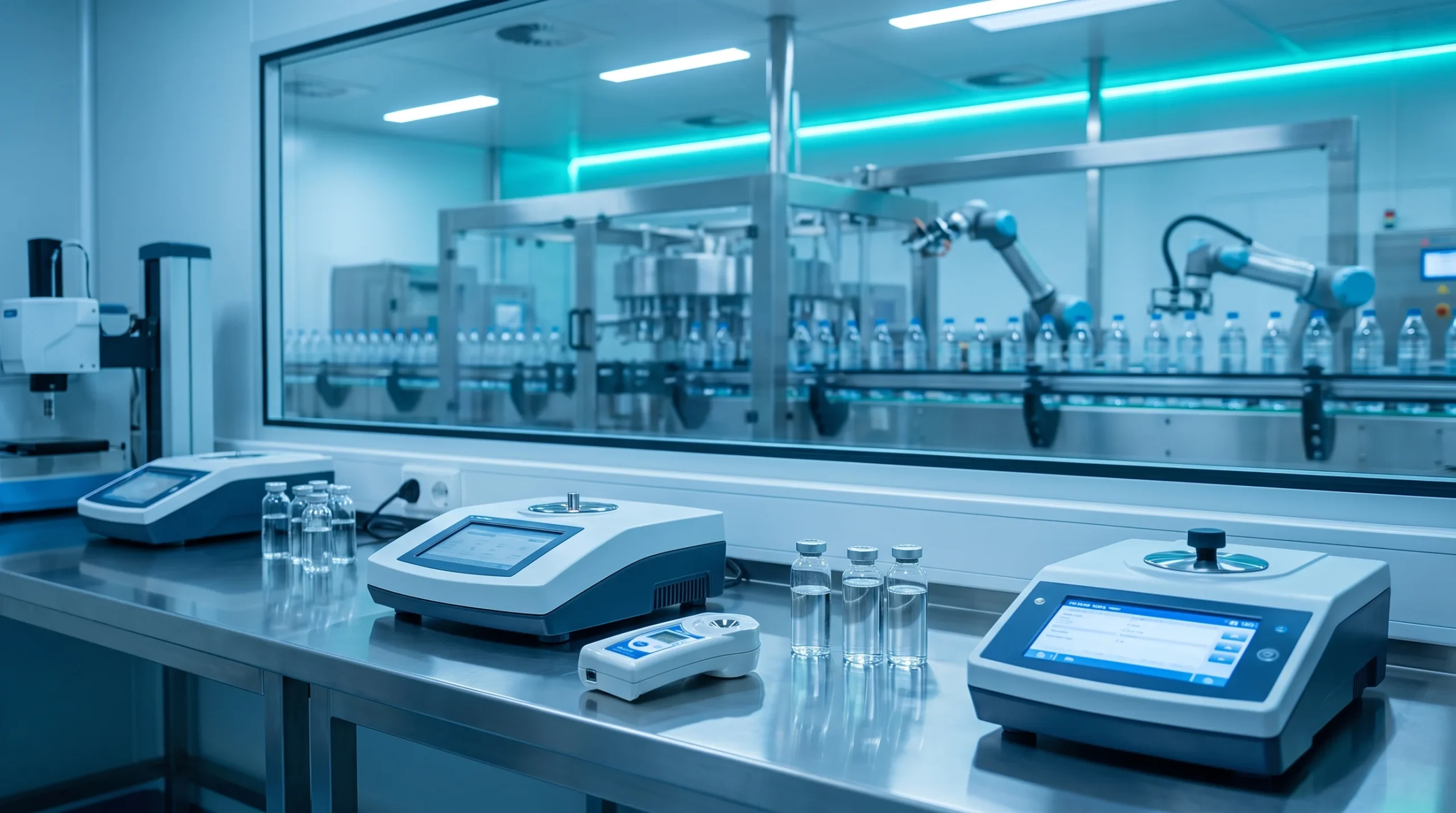
Beverage QC Applications And Matching Equipment
A quick reference for QA managers and purchasing teams. Every row is covered in more detail below, including the two measurements we do not supply.
| Beverage Application | Equipment Or Media Supplied | Brand |
|---|---|---|
| Chlorine residual at the carbon filter outlet | CL17sc continuous chlorine analyser, pocket colorimeters | HACH |
| Turbidity, hardness, alkalinity, silica and conductivity | TU5 laser turbidimeters, laboratory, portable and online instruments | HACH |
| Brix and syrup concentration | J Series automatic refractometers, DDM density meters, Brix calibration standards | Rudolph Research |
| Alcohol proof in beverage alcohol | AlcoTest-RI | Rudolph Research |
| Dissolved oxygen at the deaerator | HQ series meters with IntelliCAL probes, DO probes | HACH |
| Yeasts, moulds, lactic acid bacteria, coliforms and E. coli | Dehydrated, ready-to-use, chromogenic and selective culture media | Biokar Diagnostics |
| Incubation and media preparation | Incubators, sterilizers and water baths | Zenith Lab |
| CIP rinse verification | Portable conductivity meters and online conductivity sensors | HACH |
| Ingredient water disinfection | UV systems | Trojan Technologies |
| Bottled water arsenic, sodium and anions | Atomic absorption and ion chromatography; flame photometers for sodium and potassium | Wayeal; laboratory range |
| Bottling plant effluent | Coagulants and flocculants | Bluwat |
| Water use ratio | Full-bore and hot-tap insertion flow meters | McCrometer |
Installation, Calibration Standards And Media Supply
Instruments are installed, commissioned and calibrated by our engineers, with operator training for the shifts that will actually use them. Refractometers and density meters are supplied with traceable calibration standards so that Brix readings remain auditable, and calibration records are provided for your QA file. Probes, reagents and routine spares come from stock held in Pakistan, and warranty cover is the manufacturer’s own.
Culture media are a supply question as much as a product one. Orders can be planned against your monthly consumption so that stock arrives with usable shelf life rather than close to expiry, which matters on a microbiology bench, where one weak batch can quietly spoil a whole day of plating. Khan Associates has imported and supported laboratory and process instruments in Pakistan since 1994; installation, calibration and training are described on our services page.
Where Beverage Quality Is Actually Won Or Lost
Almost every beverage quality failure traces back to one of three places, and they need entirely different equipment.
Ingredient water determines everything downstream, including things that look unrelated to water. Blending and carbonation decide whether the product in the bottle matches the specification on the label. Microbiological integrity decides whether it still matches three months into shelf life. A plant that invests heavily in one and neglects another usually discovers the gap through a customer complaint or a regulator’s published report. Buying equipment one incident at a time, a refractometer after a Brix complaint or culture media after a spoilage incident, tends to leave exactly those gaps.
Ingredient And Process Water
Beverage plants in Pakistan typically draw groundwater or municipal supply, treat it, and then use it as the largest single ingredient. Several parameters matter well beyond simple potability.
Chlorine residual has to be controlled in two directions at once: enough through the treatment train and storage to hold microbiological control, and effectively zero at the point the water meets product, because chlorine and chlorophenol taint will destroy flavour at concentrations far below any safety concern. Grab sampling at shift intervals is a poor way to manage a parameter that moves continuously, which is why continuous chlorine measurement belongs at the carbon filter outlet. The HACH CL17sc continuous chlorine analyser is the standard instrument for that duty and is supplied in Pakistan through us, alongside pocket colorimeters for spot checks.
Turbidity is the fastest general indicator that a filtration stage is failing, and it is a release parameter in its own right for bottled water. Laser-based TU5 series turbidimeters cover both laboratory and process positions.
Hardness, alkalinity and silica are where a surprising amount of downstream trouble originates. Calcium carbonate and silica scale accumulating on carbonator injection nozzles and contact surfaces reduces CO2 absorption efficiency, and the resulting carbonation variability cannot be corrected by raising CO2 supply pressure. Plants chase this at the carbonator for weeks when the cause is in the water. Alkalinity also directly affects the acid balance and therefore the taste profile of the finished drink.
Conductivity tracks ionic content and gives a fast consistency check on treated water. The full range of HACH instruments and reagents covers these parameters across laboratory, portable and online formats, and the sc controller platform handles the continuous positions. For a plant moving from grab samples to continuous measurement, see our online analysers and controllers.
Brix, Density And Concentration Control
Brix is the number the whole blending operation is judged on, and the routine failure mode is not a bad refractometer. It is syrup temperature.
Sucrose and high-fructose syrups change viscosity with temperature, viscosity changes proportioner flow accuracy, and flow accuracy changes delivered Brix. A syrup tank drifting outside its validated temperature range should trigger Brix reverification before the run continues, not a proportioner adjustment. Plants that understand this stop treating Brix drift as a filling problem.
For measurement itself, automatic instruments remove the operator variability that makes handheld readings hard to trend. Rudolph Research J Series automatic refractometers measure refractive index and Brix with electronic temperature control and long-term repeatability, which is what makes a Brix chart meaningful rather than noisy, and the J27 portable covers production-floor and field checks. DDM automatic density meters cover density and specific gravity where concentration is better tracked that way, with the DDM 29 portable for line-side use. For distilleries and beverage alcohol, the AlcoTest-RI measures alcohol proof and obscuration without the distillation step.
One detail that matters more than the instrument choice: Rudolph’s standards laboratory supplies Brix calibration fluids and quartz control plates traceable to NIST and ICUMSA. An automatic refractometer without traceable calibration standards is an expensive instrument producing unauditable numbers. That is why Rudolph Research refractometers are supplied here with their standards.
Dissolved Oxygen And The Limits Of Carbonation Measurement
Dissolved oxygen at the deaerator outlet is a genuine control parameter. Elevated DO entering the carbonator accelerates flavour oxidation, reduces effective carbonation capacity and shortens shelf life, and typical process targets sit at or below 0.1 ppm with the deaeration system holding a specified vacuum. DO should be measured daily at the deaerator outlet and trended rather than spot-checked. HACH HQ series meters with IntelliCAL probes and HACH dissolved oxygen probes cover process water DO measurement.
Two limits apply. First, trace ppb-level oxygen in the packaged product — total package oxygen at the filler — needs a different and more specialised instrument class than general process DO measurement, and it is not something we currently confirm in our range. Second, inline carbonation measurement requires pressure-compensated instrumentation because dissolved CO2 has to be measured well above ambient pressure. We do not supply carbonation meters.
What we do measure is everything that causes carbonation to drift: the water hardness and silica that scale the carbonator, the DO at the deaerator that reduces absorption, and the Brix accuracy that shifts the product matrix. In practice most carbonation instability at Pakistani plants is one of those three rather than the carbonator itself.
Microbiological Control: Yeasts, Moulds And Heat-Resistant Spores
Beverage microbiology is not general food microbiology, because the organisms that matter are selected by the product itself.
High-sugar, low-acid soft drinks are a favourable environment for yeasts and lactic acid bacteria, and fermentation in the pack produces gas, off-flavour and turbidity. Moulds require dissolved oxygen to grow, which is why they are a still-drink and juice problem rather than a carbonated one. Modern functional and energy drinks, with milder acidity, added vitamins and minerals and reduced preservative loads, are measurably more vulnerable than a conventional cola.
The organism that costs juice producers the most is Alicyclobacillus. Its spores arrive in fruit concentrate, survive pasteurisation because they are heat resistant, and then produce a phenolic or antiseptic off-flavour in shelf-stable product, sometimes with light sediment and usually without any visible spoilage warning. The control point is screening incoming concentrate and raw materials for spores, not testing finished product and hoping.
For bottled water the requirement is different again and absolute: total coliforms and E. coli at zero CFU per 100 ml.
Biokar Diagnostics culture media cover this work. The range covers dehydrated and ready-to-use media, chromogenic media that cut confirmation steps for labs running high sample volumes, selective media and detection kits for Salmonella, Listeria, E. coli O157 and coliforms, and the peptones and agar bases for laboratories preparing custom media. In a beverage laboratory the target organisms have been stressed by acidity and preservatives, so consistent recovery from one media batch to the next matters more than unit price.
A beverage microbiology laboratory also needs incubation at more than one temperature, since yeast and mould counts and bacterial counts do not share conditions, plus a sterilizer for media preparation and glassware. Zenith Lab incubators, sterilizers and water baths cover that layer.
CIP Verification
Clean-in-place is where microbiological control is either established or quietly lost, and the measurement question is simple: when does one phase end and the next begin?
Conductivity is the most widely used parameter for CIP chemical control and final rinse verification. It confirms caustic strength is correct during the wash and confirms detergent is genuinely gone at the end of the rinse, which a timer cannot do. Residual sugar left in syrup transfer lines, manifolds and proportioner channels by an incomplete CIP is exactly the substrate that grows the yeast and mould contaminating the next batch, so rinse verification is a microbiological control, not a housekeeping one.
Conductivity measurement for CIP is covered by HACH portable meters and online sensors depending on whether you are verifying manually or building it into the cycle.
UV Disinfection Of Ingredient Water, And The Ozone Trade-Off
Ingredient water needs microbiological security without anything that changes the product. This is the case for UV.
UV inactivates microorganisms without adding a chemical, without leaving a residual, and without altering taste, odour or the mineral profile the product specification depends on. That combination is why it sits on ingredient water lines in beverage and bottled water plants rather than at the front of the treatment train. We supply Trojan Technologies UV systems, whose applications include food and beverage processing and bottled water.
Ozone is the common alternative in Pakistani bottled water plants, and it carries a consequence worth understanding before choosing it. Where source water contains bromide, ozonation forms bromate, a disinfection by-product that then has to be controlled and measured in the finished product. The reference approach for bromate is ion chromatography. If you ozonate, you need that testing capability; if you use UV for the same duty, you do not create the by-product in the first place. That is a genuine engineering trade-off rather than a product preference, and the right answer depends on your source water bromide.
Bottled Water: What The PCRWR Quarterly Report Tests
Pakistani bottled water producers face something most industries do not: a national regulator that tests their product and publishes their brand name.
Under direction from the Ministry of Science and Technology, the Pakistan Council of Research in Water Resources has monitored bottled and mineral water brands quarterly since 2005, collecting roughly 170 to 210 samples from around 20 to 21 cities each quarter, comparing results against PSQCA bottled water standards, and publishing the outcome. Results go to PSQCA, provincial governments and food authorities for action. In recent quarters, somewhere between 19 and 28 brands have been declared unsafe each time, by name.
The parameters that actually cause those failures are consistent, and each maps to a specific analytical capability:
- ✔Bacterial contamination — the single largest failure category quarter after quarter. Total coliforms and E. coli at zero CFU per 100 ml. Culture media and controlled incubation.
- ✔Sodium — repeatedly the most common chemical failure, against a PCRWR safe limit of 50 ppm. Cation analysis by ion chromatography, or flame photometry.
- ✔Arsenic — against a limit of 10 µg/L. Atomic absorption spectrometry with hydride generation is the usual route at these levels.
- ✔Potassium, TDS, sulphate and nitrate — conductivity and TDS measurement, photometric methods, and ion chromatography for the anions.
For the instrumental side of that list, Wayeal atomic absorption and ion chromatography systems cover arsenic and the anion and cation work. For a smaller plant, a flame photometer is the lower-cost route to sodium and potassium.
The commercial point is straightforward. Testing your own product against the same parameter list, on the same schedule, is considerably cheaper than appearing in the report.
Bottling Plant Effluent And Water Use
A beverage plant’s effluent is not chemically aggressive, but it is high in organic load and it swings. Product losses, syrup and concentrate residues, bottle rinse water and CIP caustic and acid rinses produce a stream with high BOD relative to COD, meaning it is largely biodegradable, and a pH that moves sharply with the CIP cycle rather than gradually.
That profile calls for equalisation and pH buffering ahead of anything else, with coagulation and flocculation handling suspended and colloidal material and a biological stage doing most of the actual load reduction. This is a very different problem from tannery or textile effluent, where the difficulty is that the COD will not biodegrade at all. Coagulant and flocculant chemistry for this duty comes through Bluwat, alongside the other effluent treatment chemicals we stock.
Water use ratio — litres of water consumed per litre of product — is the efficiency metric beverage plants are held to internally and by parent companies, and it cannot be improved without being measured. That means metering intake, key process branches and discharge separately rather than reading one main meter. McCrometer flow meters cover this, including insertion meters that install by hot tap on a live line where a shutdown is not practical.
Support For Bottling Plants In Punjab And Sindh
Beverage and bottled water plants are spread widely, and PCRWR’s quarterly sampling alone covers around twenty cities. Our Lahore team covers plants across Punjab, while plants in Karachi and the rest of Sindh work with our office in Karachi. For a site outside those areas, give us the location when you enquire so installation and training can be planned properly.
Timing matters more in this industry than most. Beverage demand peaks through the Pakistani summer, when plants run hardest and have least tolerance for downtime, so new instruments, UV systems and online analysers are best commissioned in the cooler months, with operators trained before the peak rather than during it.
Details That Help Us Specify Your QC Bench
- ✔Product categories and pack formats you run, and whether any are still, non-carbonated or low-acid, which changes the microbiological risk profile entirely.
- ✔Your ingredient water source and current treatment train, with a recent analysis if you have one.
- ✔Which parameters you currently test, at what frequency, with what instruments, and which of them you report externally.
- ✔Daily sample load for the laboratory, and for microbiology the target organisms and reference methods you work to.
- ✔Any failure or complaint you are chasing, with the actual symptom rather than the suspected cause. Carbonation drift, off-flavour and shelf-life complaints usually originate somewhere other than where they appear.
- ✔For bottled water: whether you hold PSQCA licensing and which parameters you currently send to an external laboratory.
- ✔For UV or water treatment: flow rate, water quality after existing treatment, and whether the duty is ingredient water, bottle rinse or storage recirculation.
Beverage ingredients (concentrates, flavours, sweeteners, preservatives, CO2) and filling or blending lines are not part of what we supply.
Beverage QC And Bottled Water FAQs
Our Brix Keeps Drifting During A Run. Is The Refractometer Wrong?
Usually not. Check syrup temperature first. Syrup viscosity changes with temperature, that changes proportioner flow accuracy, and delivered Brix moves with it. If syrup temperature has left its validated range, reverify Brix before adjusting anything on the proportioner. An automatic refractometer with electronic temperature control removes the second common cause, which is operator-to-operator variation in reading a manual instrument.
Why Is Our Carbonation Inconsistent When CO2 Pressure Is Correct?
Most often scale on the carbonator internals or dissolved oxygen at the inlet. Calcium carbonate and silica deposits reduce CO2 absorption efficiency, and raising supply pressure will not compensate. Elevated DO reduces effective carbonation capacity. Both are water problems measured upstream, not carbonator problems.
Do You Supply Carbonation Meters?
No. Inline carbonation measurement needs pressure-compensated instrumentation that we do not currently supply. We can supply the measurement for every upstream cause of carbonation variability.
Should We Use UV Or Ozone On Our Ingredient Water?
It depends primarily on your source water bromide. Ozonation of bromide-containing water forms bromate, which you then have to control and measure by ion chromatography. UV achieves microbiological inactivation without a chemical residual, without affecting taste or mineral profile, and without creating that by-product. If your bromide is negligible the choice opens up; if it is not, UV avoids a problem rather than managing one.
What Causes Phenolic Or Antiseptic Off-Flavour In Pasteurised Juice?
Typically Alicyclobacillus. The spores come in with fruit concentrate, survive pasteurisation, and produce the off-flavour in shelf-stable product, sometimes with light sediment and no other visible sign. Control it by screening incoming concentrate for spores rather than by testing finished stock.
What Does A Beverage Microbiology Laboratory Actually Need?
Culture media appropriate to your product risk, incubation at more than one temperature since yeast and mould counts and bacterial counts need different conditions, a sterilizer for media and glassware preparation, and basic aseptic handling equipment. For bottled water specifically, coliform and E. coli capability is not optional.
Can Conductivity Really Verify A CIP Rinse?
Yes, and it is the standard approach. Conductivity confirms caustic strength during the wash and confirms detergent has actually cleared at the end of the final rinse, which a fixed-time cycle cannot. Residual sugar left by an incomplete rinse is what grows the yeast that contaminates the next batch.
We Are A Bottled Water Plant. Which Parameters Should We Test In-House?
At minimum the ones that cause published failures: total coliforms and E. coli, sodium, arsenic, TDS, potassium, sulphate and nitrate. Microbiology and the simpler chemical parameters are realistic in-house. Arsenic at 10 µg/L and low-level cation work need instrumentation, and whether that is worth bringing in-house depends on your sample volume and how often you are currently paying an external laboratory.
Send Us Your Testing Programme
Tell us your product range, your current testing programme and the problem you are actually trying to solve, and we will recommend instruments, media or treatment equipment with a formal quotation and a note on anything outside our range. Use the enquiry form, or call or message either office.