


Tannery And Leather Industry Solutions In Pakistan
Tannery effluent treatment in Pakistan needs chemistry and measurement from the same supplier, and Khan Associates provides both from its Lahore and Karachi offices: coagulants, flocculants and decolouring agents for the ETP, laboratory instruments for chromium, sulphide, COD and BOD, and online analysers and flow meters for the plant itself.
Chromium control is one of the applications where that combination matters most. It depends on holding a narrow pH endpoint at chrome precipitation and on producing a total or hexavalent chromium result that a regulator or a brand auditor will accept. Every chemistry recommendation starts with a jar test on your own effluent: send us your effluent analysis and we will come back with a tested recommendation and a quotation.
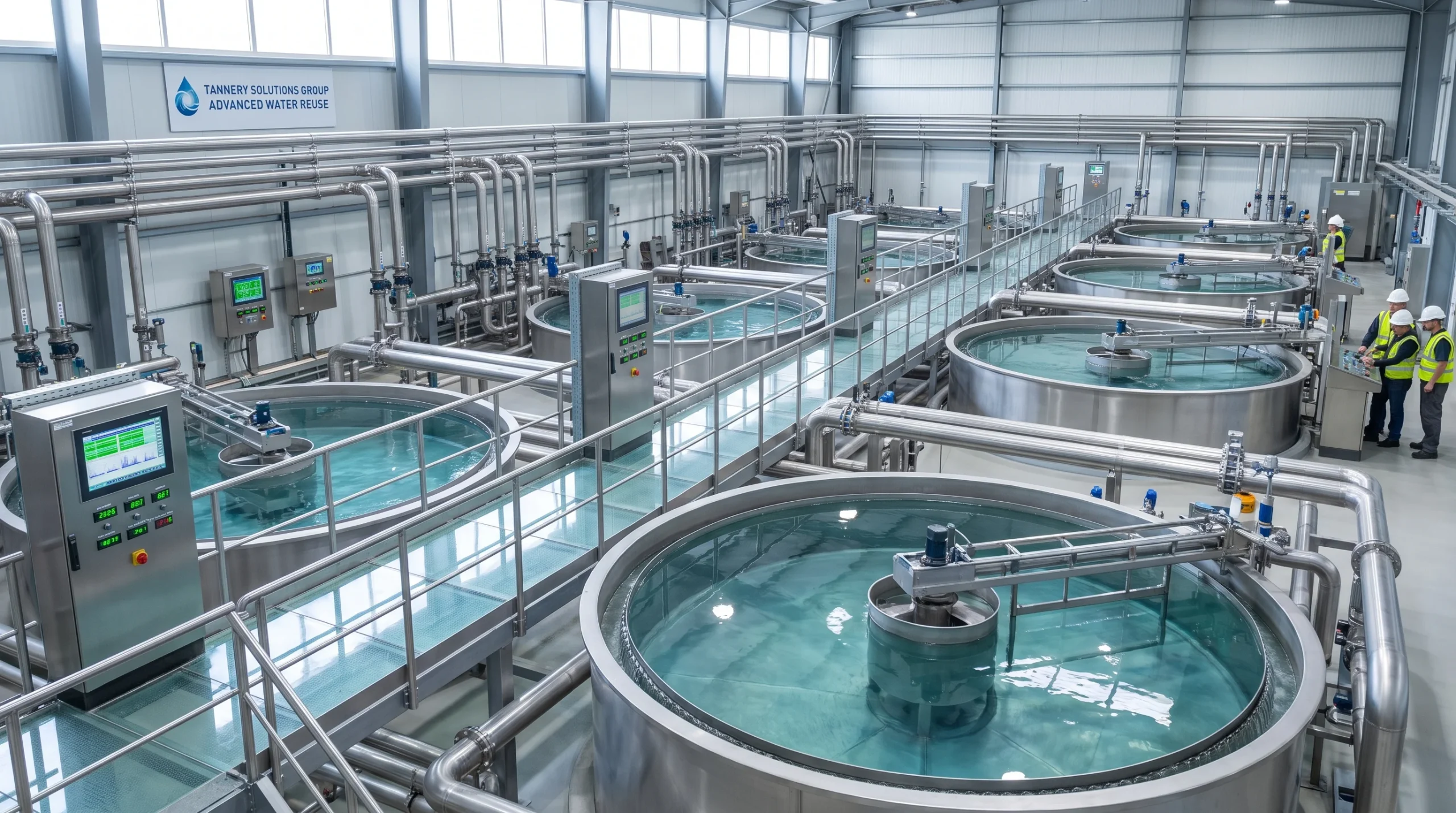
Tannery ETP And Laboratory Supply At A Glance
Each row pairs a tannery application with what we supply for it. The chemistry and method choices behind each row are explained further down the page.
| Tannery Application | What We Supply | Brand |
|---|---|---|
| Coagulation and colour removal at the ETP | Polyaluminium chloride, aluminium chlorohydrate, ferric sulphate, PolyDADMAC and polyamine coagulants, BWD-01 decolouring agent | Bluwat |
| Flocculation and sludge dewatering | Polyacrylamide flocculants in powder and emulsion form, nonionic, anionic and cationic | Bluwat, MT AquaPolymer |
| pH control at chrome precipitation and equalisation | Portable pH meters and online pH sensors on digital controllers | HACH |
| COD, nitrogen, metals and anions in the ETP laboratory | Spectrophotometers, digestion reactors and vial reagent chemistry | HACH |
| BOD, COD and Kjeldahl nitrogen | Respirometric BOD systems, COD thermoreactors, Kjeldahl digestion and distillation | VELP Scientifica |
| In-house jar testing | Flocculators and jar test apparatus | VELP Scientifica |
| Total chromium in effluent and sludge | Atomic absorption spectrophotometers | Wayeal |
| Hexavalent chromium in finished leather (ISO 17075-2) | Ion chromatography systems | Wayeal |
| BOD incubation and TSS drying | Incubators and drying ovens | Zenith Lab |
| Continuous outfall COD, ammonia and TSS | Online water quality analysers | Wayeal |
| Intake and outfall flow | Hot-tap insertion and full-bore electromagnetic flow meters | McCrometer |
Jar Testing, Local Stock And Engineering Support
Tannery chemistry is selected on your effluent, not from a product list. Our technical team runs jar tests and dosage optimisation on samples from your plant, compares coagulant and polymer options side by side, and recommends a grade and dose you can then verify on your own ETP. Khan Associates is the authorized Pakistan distributor for Bluwat and has imported and distributed chemicals and instruments since 1994.
On the laboratory side, our engineers handle installation, commissioning, calibration and operator training, and common spare parts and consumables are held in local stock so a reporting deadline does not wait on an import. Instruments carry the full manufacturer warranty, and technical data sheets, batch documentation and calibration records are supplied for your compliance file. Calibration, dosing support and training are set out on our services page.
Three Effluent Streams, Three Different Problems
Tannery effluent is one of the most difficult industrial wastewaters in the country to treat, and not because the load is unusually high. It is difficult because a tannery is really three chemically incompatible processes running in the same building, discharging into the same drain. A programme built for the average of those three streams underperforms on all of them.
Beamhouse: Soaking, Liming, Unhairing, Deliming And Bating
Sodium sulphide and lime do the unhairing. What leaves the drum is strongly alkaline, typically around pH 11 to 12.5, and loaded with sulphide, lime solids, hair and protein breakdown products, grease and organic nitrogen. The parameters that matter here are sulphide, TSS, COD, BOD, TKN and ammoniacal nitrogen, pH and oil and grease, and deliming adds a further ammoniacal nitrogen load that follows the effluent all the way to the biological stage.
Tanyard: Pickling, Chrome Tanning And Basification
Pickling puts sulphuric acid and a large quantity of common salt into the float. Chrome tanning adds basic chromium sulphate. What comes out is acidic, around pH 2.5 to 4, chromium-bearing, and extremely high in chloride and therefore in TDS. Published work on Pakistani tanneries consistently notes that only around 60 to 70 percent of the applied chromium is taken up by the hide, with the balance leaving in the spent float. That unconsumed fraction is the entire reason chrome liquor is handled as a separate treatment problem rather than being folded into general effluent treatment.
Post-Tanning And Finishing: Neutralisation, Retanning, Dyeing And Fatliquoring
Syntans, vegetable tannins, resins, dyestuffs and fatliquors produce a coloured effluent with a high COD and a poor COD to BOD ratio. This is the stream responsible for the most frustrating compliance pattern in the industry: a biological plant that is working perfectly well, a BOD result that passes, and a COD result that keeps failing. A biological stage cannot oxidise what is not readily biodegradable. That gap has to be closed chemically, upstream.
Why The Streams Have To Be Kept Apart
If acidic tanyard liquor meets alkaline sulphide-bearing beamhouse liquor, the sulphide is liberated as hydrogen sulphide gas. This is not a theoretical concern. It is the single most common reason for odour complaints, worker safety incidents and inspector attention at Pakistani tanneries, and it usually traces back to a drainage layout that was never designed for segregation, or to a sulphide oxidation step that has stopped performing.
Stream segregation is therefore the first thing to establish before discussing chemistry at all. Beamhouse liquor should reach catalytic sulphide oxidation before it mixes with anything acidic. Chrome float should reach precipitation or recovery separately. Only after those two streams have been dealt with does it make sense to equalise everything and start dosing coagulant.
Where a plant cannot physically segregate, sequencing has to be managed in time instead of in space, and that requires knowing the sulphide concentration in the beamhouse stream rather than guessing at it. It is the point at which the treatment discussion and the analytical discussion stop being separate conversations.
Chrome Liquor: Precipitation, Recovery And pH Control
Chromium precipitation is straightforward chemistry executed at a narrow pH endpoint. Raise the pH of the segregated chrome float with an alkali and chromium comes out as the hydroxide, which can either be dewatered and disposed of or redissolved in sulphuric acid and returned to the tanyard. Miss the endpoint and residual chromium stays in solution, passes downstream, and ends up either in your discharge sample or adsorbed onto sludge you now have to handle as chrome-bearing waste.
The failure here is almost never the chemistry. It is control. Manual pH checks on a batch that is still reacting will not hold an endpoint reliably, which is why plants running chrome precipitation at any scale move to instrumented pH measurement, either with portable meters used to a disciplined schedule or with a permanently installed sensor on a digital controller. We supply HACH instruments and reagents for both, including HQ series portable meters with IntelliCAL probes and the sc controller platform where measurement needs to be continuous. Verification is separate from control: residual chromium in the supernatant after precipitation is an analytical determination, not a process reading.
Coagulation, Flocculation And Colour Removal
Once the sulphide and chrome streams have been handled, the combined effluent goes to equalisation and then to physico-chemical treatment. Three questions decide what you dose: which coagulant, at what dose, and which polymer behind it.
For tannery effluent, the realistic coagulant options are polyaluminium chloride, aluminium chlorohydrate and ferric sulphate, each behaving differently against a high-organic, high-chloride, variable-pH effluent. Colour and poorly biodegradable COD from the dyeing and retanning stream generally need cationic polymer chemistry on top, whether a PolyDADMAC or polyamine coagulant or a dedicated decolouring agent. Khan Associates supplies this chemistry as the authorized Pakistan distributor for Bluwat, whose range covers spray-dried PAC, aluminium chlorohydrate, ferric sulphate, PolyDADMAC and polyamine coagulants, Blufloc polyacrylamide grades and the BWD-01 decolouring agent. Grade-by-grade detail sits with the Bluwat coagulants and flocculants, and the polymer grades from our other principals appear among our ETP polymers and coagulants.
Which of those suits your plant is not something anyone can tell you from a product list. Coagulant performance on tannery effluent depends on the mixing ratio between your streams, your working pH and your organic load, all of which vary between tanneries and between seasons in the same tannery. That is why grade selection starts with the jar test described above rather than with the grade that happened to work somewhere else. If you want the capability in-house, VELP Scientifica flocculators and jar testers are available through us as well.
Sludge Dewatering And The Cost Of Disposal
Chrome-bearing sludge is expensive to dispose of, and every percentage point of cake dryness you fail to achieve is volume you are paying to move. Dewatering performance on a belt press, decanter or centrifuge depends on matching polymer charge density and molecular weight to the sludge, which for tannery sludge means a high-charge cationic grade in most cases. Getting this wrong shows up as poor cake release, low solids capture and polymer consumption that keeps climbing.
We supply Japanese MT AquaPolymer flocculant grades, covering the ARONFLOC powder series and the ACCOFLOC emulsion series across nonionic, anionic and cationic types, with over a hundred grades available. As with coagulant selection, grade selection starts with a jar test on your own sludge.
The Tannery ETP Laboratory: The Numbers You Have To Report
Under the National Environmental Quality Standards for municipal and liquid industrial effluents, discharge to inland waters is limited on pH at 6 to 9, BOD at 80 mg/l, COD at 150 mg/l, TSS at 150 mg/l, TDS at 3,500 mg/l, sulphide at 1.0 mg/l, ammonia at 40 mg/l and oil and grease at 10 mg/l, with chromium in both its trivalent and hexavalent forms listed as a regulated parameter. Enforcement is provincial, which means Punjab EPD in Kasur, Lahore, Sialkot, Gujranwala and Multan, and Sindh EPA in Korangi.
That list translates into a fairly specific bench. A laboratory spectrophotometer with a digestion reactor and a reagent system covers COD, nitrogen and several metal and anion parameters, which is why HACH DR series instruments with TNTplus vial chemistry and a DRB200 reactor are the common backbone of an effluent laboratory. Alongside that, COD thermoreactors and respirometric BOD sensor systems from VELP COD and BOD systems handle high-throughput oxygen demand work, and VELP Kjeldahl digestion and distillation units cover total Kjeldahl nitrogen and ammoniacal nitrogen, which matter more at a tannery than at most other industrial plants because of the protein and deliming load.
The supporting equipment is not optional either. A BOD5 determination needs a temperature-controlled incubator. TSS needs a drying oven. Sample preparation needs water baths, stirrers and distilled water. Zenith Lab incubators and drying ovens cover this layer, while centrifuges, sterilizers and water distillers complete the ETP laboratory bench.
Chromium Analysis: Effluent, Sludge And Finished Leather
Chromium is one of the parameters that regulators and brand auditors look at most closely, and it has to be measured in three different places, each with its own method.
In effluent and sludge, what you usually need is total chromium, at levels where a photometric method may be adequate for routine control but atomic absorption spectrometry gives you the sensitivity and defensibility that a disputed result requires. Wayeal atomic absorption spectrophotometers cover that duty for a tannery laboratory.
In finished leather, the question is hexavalent chromium, and here the method is prescribed. ISO 17075-1 is the colorimetric route, extracting the leather under defined conditions and reading the developed colour on a spectrophotometer. ISO 17075-2 is the ion chromatography route, and where both are applied the ion chromatography result is treated as the reference, because it avoids the interference that coloured extracts cause in the colorimetric method. Both quantify down to 3 mg/kg, and sample preparation follows ISO 4044. Hexavalent chromium can also form after production during storage and ageing, which is why brands test finished articles rather than accepting process control as proof.
For a Pakistani tannery exporting to brands with restricted substance requirements, that currently means sending samples abroad or to a small number of accredited laboratories and waiting. Building the capability in-house is a real option: the colorimetric method needs a spectrophotometer and controlled extraction, the reference method needs an ion chromatograph, and Wayeal analytical instruments cover both ion chromatography and AAS at a cost well below the comparable European and Japanese platforms. Chromic oxide content in leather, expressed as a percentage rather than in mg/kg, is a separate determination and again an AAS or titrimetric job depending on the method your buyer specifies.
What Is Worth Monitoring Online, And What Is Not
Online instrumentation earns its cost where a measurement drives a control action or where a regulator expects a continuous record. At a tannery ETP, that is a short list.
pH at chrome precipitation and at equalisation is worth instrumenting, because both are control points where a drift causes a downstream failure. Dissolved oxygen in the aeration basin is worth instrumenting, because it governs aeration energy and biomass health, and tannery biology is already under stress from sulphide and chromium carry-over. HACH sc controllers with digital probes cover both. Continuous COD, ammonia and TSS at the final outfall are worth considering where a provincial authority or a brand audit expects a continuous record rather than grab samples, and Wayeal online effluent analysers cover those parameters.
What we would not recommend is putting chromium online. Continuous chromium analysis on tannery effluent is a demanding application, the maintenance burden is real, and for most plants the money is better spent on reliable pH control at the precipitation stage plus disciplined laboratory verification.
Measuring Water In And Effluent Out
Flow measurement used to be an afterthought at a tannery. It is not any more. The Leather Working Group audit protocol assesses water and energy consumption per unit of leather produced, which means an unmetered intake is a scoring problem before it is an engineering one. The current protocol also distinguishes between direct discharge from an on-site effluent plant and indirect discharge to a central or municipal plant, so the volume leaving your site is a number you are expected to know.
Retrofitting a meter onto an existing line is usually the obstacle, since nobody wants to cut pipe and stop production. McCrometer’s FPI Mag insertion meter installs by hot tap on a live line without dewatering or cutting, which makes it a practical retrofit for an intake main or an outfall that was never designed with a meter in it. Full-bore Ultra Mag and Dura Mag meters cover influent, effluent and recycle duty where the pipework can be opened. Sizing depends on line size and whether the line can be shut down, which is why McCrometer flow meters are selected against your actual pipework.
Kasur, Korangi And The CETP Question
Pakistan’s tanning industry sits mainly in Korangi, Kasur, Lahore, Sialkot, Sahiwal, Multan and Gujranwala. Two of those clusters have a combined treatment arrangement, and it changes what an individual tannery needs.
Kasur has roughly 230 tanneries and a treatment plant built under the Kasur Tanneries Pollution Control Project from 1996, rated at 13,000 cubic metres a day, along with a solid waste site and a pilot chrome recovery plant under the Kasur Tanneries Waste Management Agency. Korangi’s cluster is served by the combined effluent treatment plant operated by the Pakistan Tanners Association South Zone Environmental Society, collecting in the order of 16,500 cubic metres a day, with the Society favouring chromium recovery and reuse units installed inside individual tanneries to control the chromium load reaching the plant.
Discharging to a combined plant does not remove your obligations. Pre-treatment inside the tannery, chrome segregation and precipitation, sulphide oxidation and screening remain yours, and so does the reporting. Sampling studies at Korangi have repeatedly found chromium exceeding limits in tannery outflows while pH, TSS, TDS, BOD and COD were within them, which tells you where the attention needs to go. Tanneries in Kasur, Lahore, Sialkot, Gujranwala, Sahiwal and Multan are supported from our Lahore office in Kot Lakhpat, within reach of the Kasur cluster for sample collection and site visits. Korangi and the other Karachi tanneries are supported from our Karachi office, where the technical team carries out jar testing and dosage optimisation for local plants.
What We Need To Recommend Chemistry For Your ETP
The more of the following you can send, the faster and more accurate the response.
- ✔Which streams your drainage actually separates and where they combine. This changes the answer more than anything else.
- ✔A recent effluent analysis, ideally with pH, COD, BOD, TSS, TDS, chloride, sulphide and total chromium, and whether those are on raw, equalised or treated effluent.
- ✔Your current treatment train: sulphide oxidation, chrome precipitation or recovery, DAF or settling, biological treatment, and what dewatering equipment is installed.
- ✔Current chemical programme and consumption, including which coagulant and polymer, and at what dose.
- ✔Which parameters are failing, how often, and against which authority or audit.
- ✔For laboratory enquiries: the parameters you must report, your daily sample load, the reference methods your buyer or regulator specifies, and what instruments you already have.
- ✔For flow measurement: line size, pipe material, fluid, and whether the line can be shut down for installation.
- ✔Whether you discharge directly or to a CETP, and whether an LWG audit is in scope.
Leather process chemicals such as syntans, fatliquors, dyes and basic chromium sulphate are outside our range, as is ETP design and construction, including chrome recovery units, belt presses and DAF skids.
Tannery Effluent And Testing FAQs
Why Does Our COD Stay High Even Though The Biological Plant Is Working?
Because a significant part of the COD in tannery effluent comes from syntans, dyes and fatliquors in the post-tanning stream, and those are poorly biodegradable. A biological stage removes what is biodegradable, which is why BOD passes while COD does not. The gap has to be closed upstream with coagulant and decolouring chemistry, not by pushing the biology harder.
Which Coagulant Works Best For Tannery Effluent, PAC, ACH Or Ferric?
There is no universal answer, and anyone giving you one without seeing your effluent is guessing. Performance depends on how your streams mix, your working pH and your organic load. We jar test on your actual sample and recommend on that basis, usually comparing a polyaluminium chloride, an aluminium chlorohydrate and a ferric option along with the polymer behind each.
Do We Have To Separate The Chrome Liquor From The Rest Of The Effluent?
For any meaningful chromium control, yes. Treating chromium after it has been diluted into the combined stream means more chemical for a worse result, and it spreads chromium into sludge you then handle as chrome-bearing waste. Segregation also keeps acidic liquor away from sulphide-bearing beamhouse liquor, which is a safety issue as much as a treatment one.
What Equipment Does A Tannery ETP Laboratory Actually Need?
At minimum: a spectrophotometer with a digestion reactor and reagent system, a COD thermoreactor, a BOD route with a temperature-controlled incubator, a drying oven and balance for TSS, portable pH, conductivity and DO meters, and a jar test apparatus. Chromium determination is what distinguishes a tannery laboratory from a general effluent laboratory.
How Is Hexavalent Chromium Tested In Finished Leather?
Under ISO 17075-1 by colorimetry on a spectrophotometer, or under ISO 17075-2 by ion chromatography, with sample preparation to ISO 4044. Where both are applied, the ion chromatography result is the reference, because it is not affected by the colour of the extract. Both methods quantify down to 3 mg/kg.
Can Chromium Be Measured Continuously Online?
It is technically possible but we do not generally recommend it for tannery effluent. The application is demanding and the maintenance burden is high. For most plants, instrumented pH control on the precipitation stage combined with disciplined laboratory verification gives better control for less money.
We Discharge To A CETP. Do We Still Need Treatment And Testing?
Yes. Pre-treatment inside the tannery remains your responsibility, particularly chrome segregation and precipitation and sulphide oxidation, and the combined plant is entitled to hold you to an inlet quality. The Leather Working Group audit protocol also distinguishes indirect discharge from direct discharge rather than exempting it, so your own numbers still have to exist.
Can Treatment Chemistry Bring Our TDS Down?
Largely no. TDS in tannery effluent is dominated by chloride from curing salt and pickling. Coagulation and flocculation remove suspended and colloidal material, not dissolved salt. Reducing TDS means reducing salt entering the process, recovering pickle liquor, or installing a desalination step, and none of those is a chemical dosing decision.
Get A Jar Test On Your Effluent
Send us your effluent analysis and a short description of your treatment train, or tell us which parameters you are struggling to report, and we will come back with a technical recommendation and a formal quotation. Where treatment chemistry is involved, we jar test your own sample first. Send us the details through the enquiry form, or reach us directly.