


Effluent Treatment Plant Chemistry, Monitoring, UV Disinfection And Flow Metering In Pakistan
An effluent treatment plant runs on chemistry and measurement, and Khan Associates supplies both into operating plants across Pakistan from Lahore and Karachi.
That means coagulants, decolouring agents and polymers for clarification and sludge dewatering, laboratory and online instruments for the parameters you report, UV systems for disinfection before discharge or reuse, and flow metering at the inlet and the outfall. The buyers are ETP managers and incharges, environmental and compliance engineers, laboratory staff, and the consultants and contractors who specify for them. Khan Associates does not design or build treatment plants. It supplies the consumables and equipment that keep an existing plant within its limits, and has served Pakistani industry since 1994.
The difficulty at most plants is not the design figure but the daily swing. Influent changes with every production shift, while the NEQS ceiling for COD into inland waters stays at 150 mg/L and export buyers often set tighter numbers. Send the latest effluent analysis, flow rate and the parameters you report, and we will recommend chemistry, instruments or both, with a formal quote.
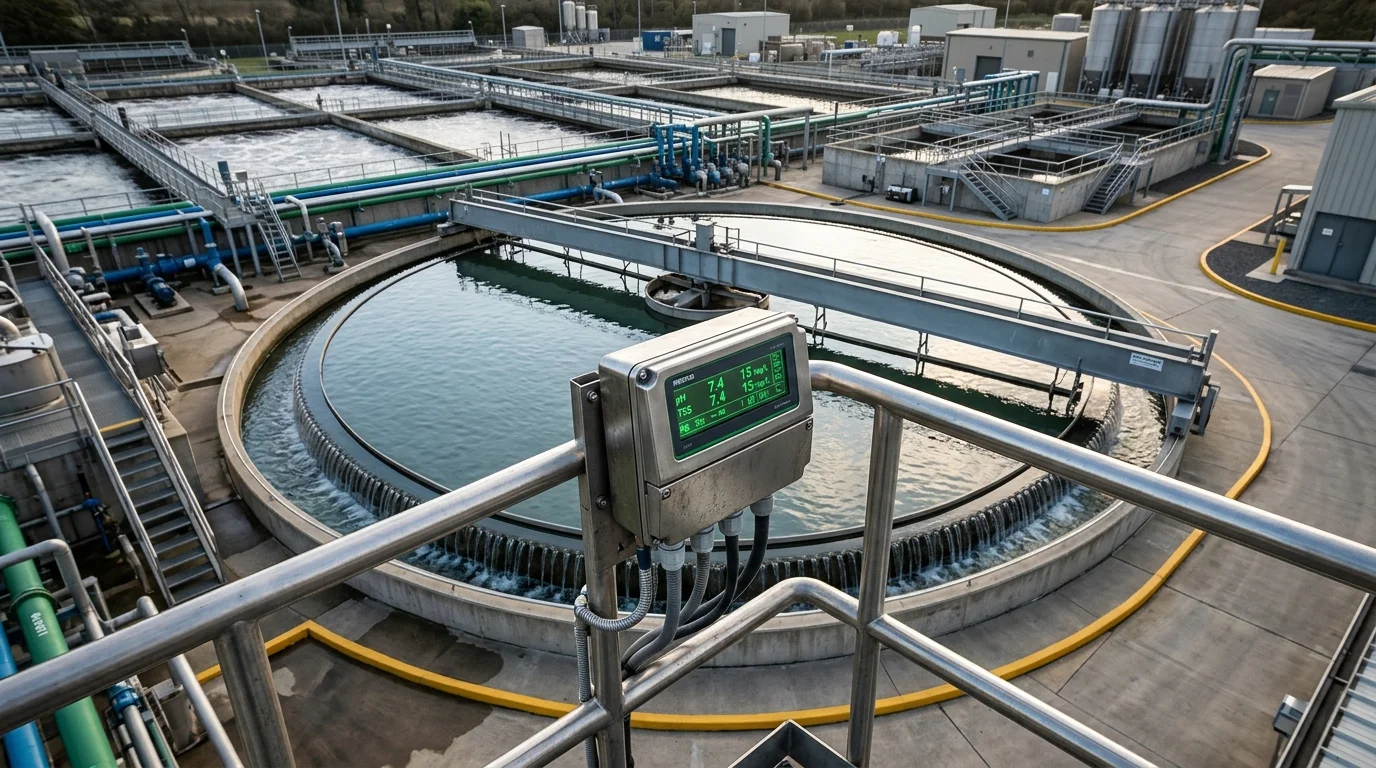
What We Supply Across The Treatment Train
Each row pairs a stage in the treatment train with the products we can supply there. Individual coagulant and polymer grades are listed in our wastewater chemicals range; the sections below explain where each one fits in the plant.
| Treatment Stage | Requirement | What Khan Associates Supplies | Brand |
|---|---|---|---|
| Equalisation and neutralisation | Stable pH ahead of chemical and biological stages | pH probes with sc controllers | HACH |
| Coagulation and colour removal | Remove colloids, dye colour and some of the COD | BWD-01 decolourant used with PAC, PolyDADMAC or polyamine | Bluwat |
| Flocculation, clarification and DAF | Strong, settleable or floatable floc | Polyacrylamide flocculants | Bluwat, MT AquaPolymer |
| Aeration (activated sludge, MBBR, SBR) | Dissolved oxygen control, ammonia and nutrient removal | Optical DO probes, ammonium, nitrate and phosphate analysers | HACH |
| Secondary clarification | Sludge blanket and suspended solids control | TSS and sludge level sensors | HACH |
| Sludge thickening and dewatering | Drier cake, clearer filtrate | Cationic dewatering polymers, powder and liquid | MT AquaPolymer, Bluwat |
| Disinfection before discharge or reuse | Microbial reduction without a chemical residual | UV disinfection systems, lamps and sleeves | Trojan Technologies |
| Inlet and outfall | Flow for dosing and discharge reporting | Electromagnetic meters, insertion and full-bore | McCrometer |
| Final outfall record | COD, TSS and ammonia measured continuously | Online effluent analysers | Wayeal |
| ETP laboratory | COD, BOD, nutrients and colour | Spectrophotometers, vial reagents, digestion reactors, COD thermoreactors and BOD respirometers | HACH, VELP Scientifica |
Support Behind The Chemistry And The Instruments
Chemistry for an ETP has to be selected against the effluent the plant actually receives. Jar testing and dose optimisation are done by our technical team on samples of your effluent or sludge before plant-scale supply, every Bluwat batch ships with its certificate of analysis, and incoming product is verified in Khan Associates’ in-house QC laboratory. Treatment chemicals are stocked in Lahore and Karachi and tracked through an ERP system, which matters to a plant that doses every shift and cannot run short mid-month.
For instruments, our engineers install, commission and calibrate, and train the operators who will use them, with the scope described under our technical services. HACH reagents are held locally, McCrometer meters come with sizing support and hot-tap installation guidance, and genuine Trojan lamps and quartz sleeves keep the delivered UV dose where it was designed. Khan Associates holds authorized distribution for Bluwat, MT AquaPolymer, HACH, Trojan Technologies and McCrometer, and serves more than 1,000 clients across Pakistani industry.
Clarifying The Effluent: Coagulants, Decolourants And Flocculants
After equalisation, the chemical stage does two jobs in sequence. A coagulant neutralises the charge on colloids, dye molecules and fine suspended matter so they can come together; a flocculant then bridges those particles into floc large enough to settle in a clarifier or rise in a DAF unit. Chemical-stage problems usually show up as pin floc carrying over the clarifier weir, colour passing straight through, or a dose that was right last month and is wrong this week because production changed.
Overdosing causes as much trouble as underdosing: excess coagulant restabilises the particles and adds sludge and dissolved solids, and excess polymer leaves a sticky floc that blinds filters.
Bluwat coagulants and decolouring chemistry cover this stage. Polyaluminium chloride is the usual inorganic coagulant, with ferric sulphate or aluminium chlorohydrate as alternatives where pH or sludge handling favours them. PolyDADMAC and polyamine are organic coagulants that can take over part of the inorganic dose and so reduce chemical sludge. BWD-01 is Bluwat’s cationic decolouring agent for dyeing, printing and pigment effluent; Bluwat states colour removal of up to 99 percent and COD reduction of 50 to 80 percent when it is combined with PAC or another inorganic coagulant. It is dosed alongside PAC, never pre-mixed with it, and the order and ratio come from testing.
Colour is where the effluent itself decides the chemistry. Disperse and vat dyes coagulate fairly readily; highly soluble reactive dyes do not, which is why a textile ETP can meet its COD limit and still discharge visibly coloured water. Behind the coagulant, Bluwat polyacrylamide flocculants are chosen by charge: an anionic grade usually follows an inorganic coagulant in a clarifier, while cationic grades suit organic and biological solids.
How A Jar Test Sets The Dose
A jar test reproduces the chemical stage in a row of beakers. A composite sample is drawn from the equalisation tank outlet, ideally covering a normal shift and the worst one. Each beaker gets a different coagulant dose under rapid mixing, then the flocculant under slow mixing, and the samples settle for a fixed time. Supernatant turbidity, colour and COD, floc size and settled sludge volume are compared, and the series is repeated with a second coagulant or a decolourant. The outcome is a grade, a dose and an order of addition, to be rechecked whenever the factory’s product mix changes.
Our technical team runs these tests on your samples. Plants that prefer to run their own can use VELP Scientifica’s flocculator units, which hold mixing speed and timing constant from one test to the next.
Sludge Dewatering And Disposal Volume
Every kilogram of solids removed upstream ends up as sludge, and most of what a plant pays to haul away is water. Whether the plant runs a belt press, a decanter centrifuge, a screw press or a filter press, performance comes down to fitting the polymer’s charge density and chain length to the sludge. A grade that is slightly wrong gives a wet cake, a cloudy filtrate that returns solids to the head of the works, and polymer use that creeps upward as operators compensate.
MT AquaPolymer dewatering polymers from Japan are the core of this stage. The manufacturer’s naming is worth knowing: ARONFLOC grades are cationic and are recommended by MT AquaPolymer for organic sludge from sewage and industrial wastewater, with a CX series for sludge that is hard to dewater, while ACCOFLOC grades are anionic and nonionic and are used for solid-liquid separation, typically where the solids are largely inorganic. Both lines come as powder and as the E Series high-concentration liquid.
Powder or liquid is a plant decision as much as a chemical one. According to MT AquaPolymer, powder grades take 40 to 60 minutes to dissolve more than 90 percent and need a make-up unit, while E Series liquids are usable within minutes, suit automatic make-up and compact dosing skids, and do not dust, although the emulsion must be kept stirred. A plant with a working powder system and steady sludge may stay with powder; one with limited operator time or frequent stops often does better on liquid.
Bluwat’s Blufloc grades also cover dewatering, and some plants pair Bluwat chemistry at the clarifier with an MT AquaPolymer grade at the press; where both could suit, they are trialled side by side.
Biological Treatment: Aeration, Nutrients And Settling
In activated sludge, MBBR and SBR plants, dissolved oxygen is the variable that matters most. HACH notes that roughly 70 percent of a wastewater plant’s energy goes to aeration blowers, and many plants run them continuously at more oxygen than the biology needs. HACH LDO optical probes measure dissolved oxygen without membranes or electrolyte to replace, and on an sc controller they let blowers follow demand.
Ammonium, nitrate and phosphate analysers show whether nitrification and nutrient removal are working well before a weekly laboratory result does, and TSS and sludge blanket sensors in the secondary clarifier warn of solids loss. These sit within the HACH process and laboratory range.
Bulking sludge deserves a plain warning. Filamentous bulking is usually traced to low dissolved oxygen, a low food-to-microorganism ratio, nutrient deficiency or septic influent. Settling polymers and coagulants can rescue a bulking clarifier, but published reviews describe that relief as temporary, sometimes followed by worse bulking when dosing stops. Correct oxygen and nutrients first, and treat polymer as a bridge rather than the fix.
Monitoring Discharge: Laboratory Results And Online Records
A grab sample tells you what the plant discharged; continuous monitoring lets an operator correct dosing before an exceedance happens.
The laboratory measures COD, nutrients and colour against limits. DR series spectrophotometers from HACH, used with TNTplus vial reagents and a DRB200 reactor, form the usual backbone for COD, nitrogen, phosphorus and colour, and VELP Scientifica’s COD digestion thermoreactors and respirometric BOD sensors take higher sample volumes. BOD takes five days, so it confirms performance after the event; COD and online readings are what an operator acts on during the shift.
At the outfall, Wayeal online analysers measure COD, BOD, TSS and ammonia nitrogen continuously, which is useful where an approval condition or a buyer’s audit asks for an unbroken record instead of spot results.
Limits come from several directions. The NEQS ceilings for inland-water discharge are pH 6 to 9, BOD 80 mg/L, COD 150 mg/L, TSS 200 mg/L and TDS 3,500 mg/L, with separate figures for discharge to sewage treatment. Punjab’s 2016 effluent standards keep the core limits and set testing frequencies, including COD twice a month and TSS daily. For textile exporters, the ZDHC Wastewater Guidelines (version 2.2, 2024) set foundational limits of COD 150, BOD 30 and TSS 50 mg/L, together with colour limits that the NEQS do not include.
One distinction matters for reporting. Under the Self-Monitoring and Reporting by Industry Rules, 2001, results submitted to the EPA must come from a certified environmental laboratory that is not part of the reporting unit. An in-house ETP laboratory supports process control and early warning; it does not replace that certified testing.
UV Disinfection Before Discharge Or Reuse
Disinfection becomes necessary when treated effluent is reused, for example to irrigate plant grounds, and at sewage treatment plants serving colonies and towns. UV disinfects without adding a chemical: Trojan Technologies notes that it forms no disinfection by-products, removes the need to transport and store chemicals, and is effective against chlorine-resistant protozoa such as Cryptosporidium and Giardia.
Trojan’s wastewater systems, such as the TrojanUV3000Plus, install in existing effluent channels and chlorine contact chambers, use amalgam lamps, and have been validated through microbial testing for E. coli and fecal coliform. The ActiClean system cleans the quartz sleeves while the lamps keep running.
UV only works on water it can see through. A UV system is sized on flow, the UV transmittance of the treated effluent and the dose required, and both colour and suspended solids lower transmittance and shield organisms. Coloured textile effluent or a poorly settled secondary effluent is not a UV candidate until upstream treatment is right, so transmittance should be measured before a system is specified. Genuine replacement lamps and sleeves keep the validated dose; see the Trojan UV disinfection systems for the municipal and industrial range.
Flow Measurement At The Inlet And The Outfall
Chemical dose is set in milligrams per litre, so a plant that does not know its flow does not know its dose. Flow also turns a concentration into a load, and a discharge report without it is only half a number.
On an operating ETP the obstacle is usually installation. The McCrometer FPI Mag can be inserted into a live effluent main through a hot tap, with no draining and no interruption to treatment. Full-bore meters from the Ultra Mag and Dura Mag lines suit new pipework on treated effluent and recycle lines. Electromagnetic meters need a full pipe, so gravity channels and partly filled outfalls call for a different approach, to be confirmed during sizing. McCrometer electromagnetic flow meters are sized against your pipe diameter, material and straight run.
Effluent Treatment Across Industries
- ✔Textile processing: colour, reactive dyes and ZDHC limits drive decolourant and coagulant selection.
- ✔Tanneries: chrome-bearing and sulphide streams need segregation before chemistry; see our tannery and leather industry page.
- ✔Pharmaceuticals: coagulation serves as pretreatment ahead of biological treatment or advanced oxidation; see pharmaceutical manufacturing support.
- ✔Food and sugar: high organic load and seasonal surges make equalisation and biological capacity the main issues; see our food and sugar industry page.
- ✔Beverage: largely biodegradable effluent with sharp pH swings from CIP; see the beverage industry page.
- ✔Chemical, paper and general industry: variable, often poorly biodegradable streams where jar testing matters most.
- ✔Municipal and colony sewage plants: dewatering polymer, flow measurement and UV ahead of reuse.
CETPs And Industrial Clusters In Pakistan
Outside a few combined plants, ETPs in Pakistan are in-house plants at individual factories, many of them in the textile and processing belts around Faisalabad, Lahore and Sheikhupura and in Karachi’s industrial estates. The Korangi CETP, established by the PTA (Southern Zone) Environmental Society, is designed for 42,000 m³ per day, including 16,500 m³ of tannery wastewater from around 150 tanneries, and uses UASB anaerobic treatment. In 2018 the federal and Sindh governments approved Rs11.8 billion for five combined effluent treatment plants for Karachi’s industrial areas.
Karachi plants in SITE, Korangi, Landhi and Port Qasim deal with our Karachi office; Punjab plants in Faisalabad, Kasur, Sialkot or Multan are looked after from our Lahore office. Neither office is in those cities, so visits for sampling and site work are arranged with each enquiry.
What To Send With An ETP Chemistry, Instrument Or UV Enquiry
- ✔Effluent characteristics: a recent analysis of raw and treated effluent covering COD, BOD, TSS, TDS, pH and colour, and the processes it comes from.
- ✔Flow: average and peak flow, and how much it varies between shifts.
- ✔Treatment stages installed: equalisation, chemical treatment, DAF or clarifier, biological process, tertiary filtration and sludge equipment.
- ✔Current dosing: chemicals, doses, make-up equipment and recent problems such as carryover, colour or wet cake.
- ✔Parameters to monitor: what you test now, how often, with which instruments, and what you want online.
- ✔Discharge route and limits: inland water, sewer or sea, provincial standards, any buyer or ZDHC requirements, and reuse plans.
- ✔For UV and flow meters: UV transmittance if known, pipe or channel size and material, and if that line can be isolated.
Khan Associates does not design, build or operate treatment plants, supply clarifiers, presses or blowers, or issue certified environmental test reports.
Effluent Treatment Plant FAQs
How Do I Choose Between PAC And An Organic Coagulant?
PAC is the usual starting point and works across a broad pH range. Organic coagulants such as PolyDADMAC and polyamine can replace part of the PAC dose to cut chemical sludge and dissolved solids. A side-by-side jar test with your effluent shows whether a blend gives the same clarity at lower total cost.
Why Does Our Effluent Stay Coloured When COD Is Within The Limit?
Highly soluble reactive dyes contribute little COD but strong colour, and they do not coagulate easily. A cationic decolouring agent such as BWD-01, dosed with PAC, is the usual answer, with the ratio set by jar testing.
Should The Decolouring Agent Be Mixed With PAC Before Dosing?
No. Dose them separately; the order of addition and the ratio between them are set by testing on your effluent.
Powder Or Liquid Polymer For Our Belt Press?
Powder suits a plant with a working make-up unit and steady sludge. Liquid E Series grades dissolve within minutes and suit automatic dosing or limited operator time. Test both on your sludge before deciding.
Can Polymer Fix Bulking Sludge In The Aeration Tank?
Only temporarily. Bulking usually comes from low dissolved oxygen, a low food-to-microorganism ratio, nutrient deficiency or septic influent, and polymer improves settling without removing the cause. Correct oxygen and nutrients first.
Can Our In-House Laboratory Results Be Used For EPA Reporting?
Not under the 2001 self-monitoring rules, which require results from a certified environmental laboratory that is not part of the reporting unit. The in-house laboratory is for process control.
Is UV Suitable For Treated Textile Effluent?
Only where upstream treatment leaves the water clear enough. Colour and suspended solids reduce UV transmittance, so measure it on your treated effluent before a system is sized.
Can A Flow Meter Be Fitted Without Shutting Down The Effluent Line?
Yes, on a full pipe. The FPI Mag from McCrometer is inserted through a tapping made while the line stays in service. Partly filled outfalls need a different approach.
Do You Design Or Build Effluent Treatment Plants?
No. We supply chemistry, laboratory and online instruments, UV systems and flow meters into plants designed and built by others, and support them with jar testing, installation and calibration.
Send Your Effluent Data For A Recommendation
Share your effluent analysis, flow and treatment stages, and say whether the question is chemistry, monitoring, disinfection or flow. You will receive our recommendation with a quotation, and where chemistry is involved we will arrange jar testing of your sample. Reach us through the enquiry form, by email to either office, by telephone, or on WhatsApp.